Stabilization Models — ISF, IDST, CSM
The stabilization route collects the Infinite Stabilization Formula, Infinite Digital Structure Theorem, Complete Stabilization Model, recursive closure systems, Lyapunov/semigroup/categorical stabilization, and related proof targets. These are public formalization targets unless machine-checked proof or external review is explicitly shown.
Public status boundary. This page is part of an authorial public research corpus. It may contain original frameworks, formalization targets, manuscripts, public archive records, implementation designs, and source routes. It does not assert accepted proof, peer review, experimental validation, institutional endorsement, legal certification, or global deployment unless that evidence is explicitly provided.
Relation to SFR
This page is one node in the Science of Fabric Reality. It should be read through the shared grammar of relation, invariant, trace, observer, closure, and boundary.
Core primitives
| Primitive | Working meaning |
|---|---|
| Structure | the organized carrier of relations. |
| Relation | lawful connection between distinguishable elements. |
| Invariant | preserved feature under admissible transformation. |
| Trace | inspectable record of transformation. |
| Observer | context of measurement, approval, interpretation, or state selection. |
| Boundary | claim status and domain of validity. |
| Failure mode | the condition under which the model breaks or must be revised. |
Formalization targets
- Define objects and morphisms.
- Define admissible transformations.
- State invariants and preservation obligations.
- Declare trace functions and observer context.
- Build lemma dependency graph.
- Identify domain restrictions and counterexample classes.
- Route mathematical claims to Lean/HoTT/Coq or proof-paper development.
- Route physics claims to simulation, observable, and falsifiability registry.
Failure modes
| Failure | Public risk | Required correction |
|---|---|---|
| Undefined terms | reader cannot evaluate claim | add glossary and symbol table. |
| Unsupported strength | overclaim | downgrade to proposed framework or formalization target. |
| Missing review route | no scientific pathway | add proof, simulation, or falsifiability target. |
| Media substitution | video treated as validation | mark videos as exposition only. |
| Source drift | record cannot be traced | add source note and registry entry. |
Internal links
graph TD
A[Stabilization Models — ISF, IDST, CSM] --> B[SFR]
B --> C[Invariant Engineering]
A --> D[Formalization Targets]
A --> E[Review Gateway]
A --> F["Publications / Media"]
Review Path
Every serious reader may review this page through five gates:
- Definition gate — terms, symbols, and scope must be defined.
- Boundary gate — the claim must be marked as accepted science, interpretation, proposed framework, formalization target, public record, operational design, software prototype, or strategic vision.
- Source gate — references, manuscripts, videos, code, datasets, or source notes must be traceable.
- Formalization gate — mathematical claims should be reducible to assumptions, definitions, lemmas, theorem statements, and proof obligations.
- Falsifiability / implementation gate — physics claims need observables and failure conditions; software claims need implementation scope and reproducible evidence.
Related: Public Review Gateway, Formalization Targets, Publications, Media.
Visual Directives
- Hero figure: restrained, institution-grade diagram; no mystical or triumphalist imagery.
- Diagram style: lattice, graph, archive spine, proof ladder, invariant registry, or source-route map.
- Caption rule: every figure must say whether it is a conceptual model, formalization target, source map, or implemented software feature.
- Card layer: use compact cards for definition, status, primitives, review path, failure modes, and source route.
Infinite Stabilization Formula (ISF)
Scientific Position
The Infinite Stabilization Formula, or ISF, is the first major formal-law layer of the theoretical architecture presented in this compendium. If Principia Fabrica establishes the primacy of lawful fabric structure and Teoria Fabrica Realica gives that claim ontological depth, ISF addresses a new and unavoidable question: under what law can recursive, extending, or potentially unbounded structures remain coherent rather than collapse into divergence, drift, or degeneration.
Within the broader program, ISF is therefore a theory of lawful stabilization. Its role is not merely descriptive. It provides a formal principle for understanding how complex and recursively unfolding systems can maintain continuity of structure under growth, iteration, feedback, and extension. In this respect, ISF is a decisive transition point between ontological first principles and later structural, mathematical, and engineered applications.
The importance of ISF lies in the fact that any theory claiming structural primacy must eventually confront the problem of persistence under continuation. It is not enough to say that reality is fabrical or relationally constituted. One must also explain how such reality remains ordered when it becomes recursive, layered, dynamic, or indefinitely extensible. ISF enters precisely at that point. It is a law of admissible continuation.
Core Definition
ISF may be defined as the formal principle according to which a recursively extending structure remains admissible only insofar as its continuation preserves stabilization under lawful transformation, bounded structural drift, and non-degenerate persistence.
In conceptual terms, stabilization here does not mean static immobility. It means ordered persistence through transformation. A structure may evolve, unfold, branch, or recursively elaborate itself, but that elaboration must remain governed by conditions that preserve coherence, prevent arbitrary collapse, and maintain lawful continuity across stages of development.
Under this definition, ISF concerns the admissibility of continuation itself. It is not a generic equilibrium condition. It is a formal doctrine stating that recursive or unbounded structural processes must be constrained by stabilization laws if they are to remain part of a coherent fabric of reality or system architecture.
Figure ISF-01. Infinite Stabilization Formula: Law of Admissible Continuation.
The diagram represents ISF as a formal principle governing recursive development. A process undergoing iteration, growth, or feedback is tested against stabilising constraints. Continuation that departs from structural identity leads toward drift or degeneration, while continuation satisfying bounded variation, coherence, and lawful preservation remains admissible. The figure is a formal-principle schematic and does not itself establish convergence, universal stabilisability, or experimental validation.
Foundational Claim
The foundational claim of ISF is that recursive continuation without stabilization law is structurally inadmissible.
This claim may be expressed more formally as follows. Let denote a structure and let denote its recursive continuation. Let denote a lawful stabilization operator and a horizon of admissible higher-order structural containment. Then the stabilization principle may be stated in the canonical form associated with the wider program:
where denotes the stabilized admissibility profile of the structure.
The meaning of this expression is that recursive continuation alone is insufficient. A structure becomes admissible only where recursive unfolding is filtered through stabilization and remains within a lawful horizon of containment. Continuation that escapes all such discipline ceases to be structurally valid in the sense required by the broader program.
Scientific Context
The scientific context of ISF lies at the intersection of recursive systems, logic, dynamical order, hierarchy theory, and the formal analysis of persistence conditions. It addresses a problem that appears in many domains under different names: how to prevent unbounded generative processes from becoming incoherent.
In mathematics and logic, this appears wherever one must distinguish well-founded extension from circular or pathological recursion. In systems theory, it appears in the problem of preserving coherent organization under feedback, amplification, and scale increase. In computational settings, it appears in questions of termination, bounded drift, and valid continuation. In ontology, it appears whenever a structurally real world is understood as dynamic rather than static.
The importance of ISF in this context is that it generalizes stabilization into a first-class formal principle. Instead of treating coherence as an after-the-fact property of fortunate systems, it makes stabilization part of the law that governs whether recursive continuation is admissible at all.
This also explains its central position in the wider compendium. ISF is one of the first theories to translate the ontological claims of the earlier chapters into a more explicit formal discipline. It prepares the ground for later theories of infinite structure, invariant-preserving architecture, and field or system-level stabilization.
Foundational Contributors and Prior Influence
Among prior contributors, Adrian Mathias is especially important for the scientific atmosphere surrounding ISF. His work in well-foundedness, hierarchy, and structural rigor helps define the broader intellectual environment in which questions of admissible recursive continuation become mathematically serious. Although ISF is not reducible to Mathias's work, his influence is strongly relevant wherever structural extension must be kept non-circular and ordered.
Kurt Gdel also provides a critical background through the logic of formal limit. Any theory of stabilization that aspires to high generality must remain aware that sufficiently expressive systems cannot wholly secure themselves from within. Gdel's relevance here is disciplinary. He helps prevent overstated closure and reminds the architecture of the difference between lawful stabilization and total formal self-guarantee.
Alan Turing contributes through the problem-space of recursive process, computability, and the formal conditions under which process remains intelligible. Where ISF later informs executable or architectural reasoning, Turing's background becomes increasingly important.
A broader influence may also be traced to mathematical and physical traditions concerned with energy descent, coherence conditions, and the persistence of order under iteration or flow. These do not by themselves constitute ISF, but they help make visible the scientific necessity of a stabilization law.
Key Concepts
The concept of stabilization denotes lawful persistence under recursive continuation. The concept of recursive admissibility names the condition under which extension remains structurally valid. The idea of a continuation horizon indicates that not every possible elaboration belongs to the same lawful order. The notion of bounded structural drift refers to the requirement that transformation remain disciplined rather than arbitrary. The concept of non-degenerate persistence names continuity that preserves structural identity without reducing development to stasis. The idea of lawful containment indicates that higher-order extension must remain within a coherent organizational regime.
Main Structural Components
The first structural component of ISF is the distinction between continuation and admissibility. A structure may continue in many ways, but only some continuations are stabilized. This separates mere extension from valid structural unfolding.
The second component is the stabilization operator itself. ISF requires that recursive elaboration be filtered through a lawful transformation that preserves coherence. This filtering function is what prevents recursive generation from becoming structurally arbitrary.
The third component is the admissibility horizon. Recursive systems cannot be treated as unconstrained infinities. Their extension must remain bounded by a higher-order condition of lawful containment. This gives the theory both rigor and protection against unstructured escalation.
The fourth component is the rejection of collapse into either chaos or rigidity. Stabilization in ISF does not mean freezing development. It means preserving coherent transformability. The theory therefore holds a middle position between disorder and dead stasis.
The fifth component is transferability. Although ISF arises at a formal level, its logic is intended to extend into later domains, including digital structure, invariant engineering, recursive fields, and complex architectures. It is thus both a local law and a transportable principle.
The Complete Stabilization Model
The Complete Stabilization Model
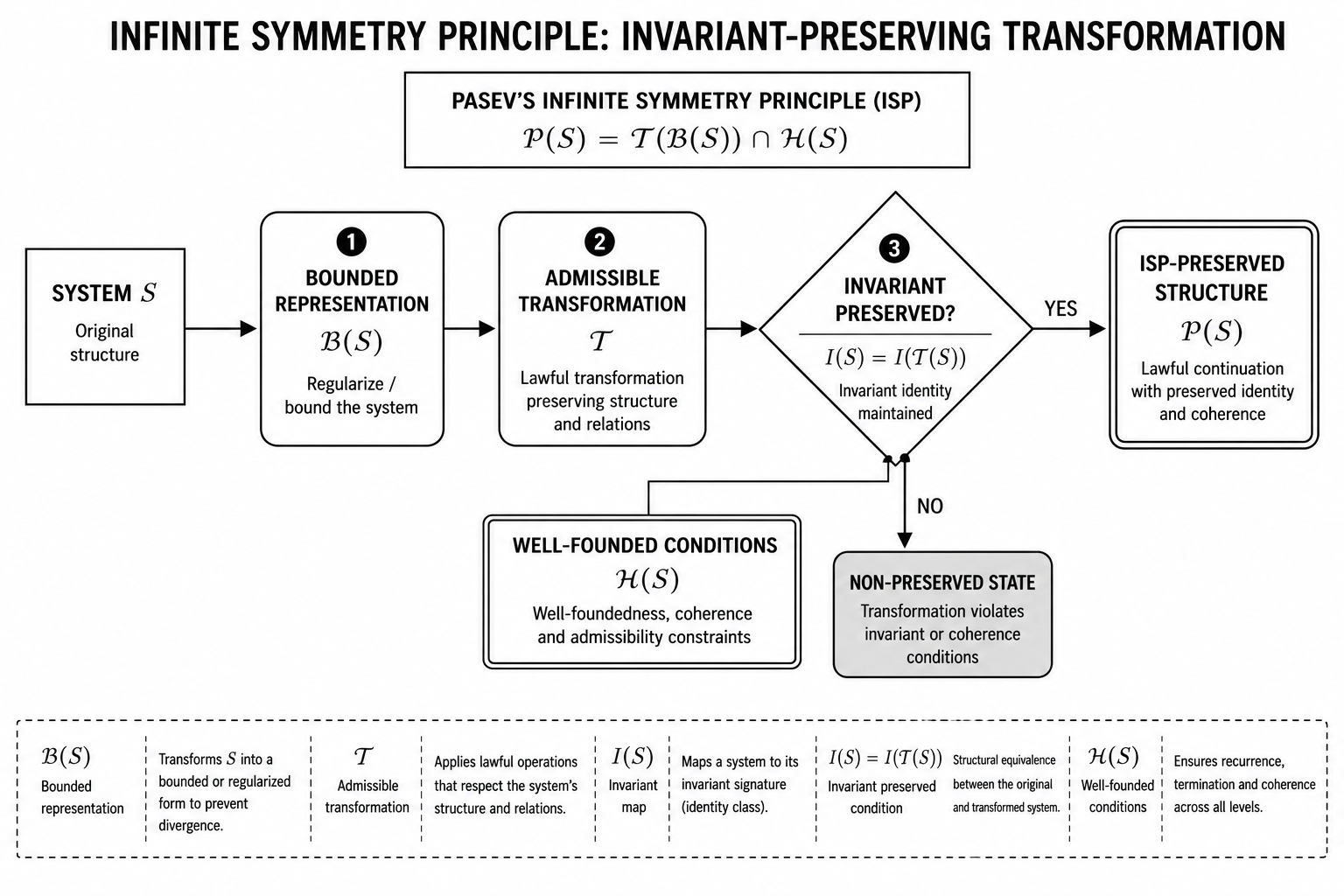
The Infinite Stabilization Formula introduces the problem of coherence under recursive extension. The Complete Stabilization Model develops that problem into a more explicit mathematical, logical, and architectural doctrine. Its purpose is not merely to state that recursive systems must remain stable, but to define the layered conditions under which such stability can be understood, tested, transferred, and preserved across increasingly complex structures.
Within the broader science of fabric reality, stabilization is not identical with stillness. A stabilized system may transform, expand, recurse, differentiate, and incorporate new domains. What stabilization forbids is not motion, but incoherent motion. It forbids transformation that destroys the identity of the structure being transformed. It forbids recursion that amplifies contradiction faster than order. It forbids extension that produces scale without continuity. In this sense, stabilization is the governing law by which fabric avoids collapse into aggregation.
The Complete Stabilization Model therefore occupies a decisive position in the architecture of the program. Principia Fabrica establishes that fabric is a lawful composition of relations, constraints, continuities, and transformations. Teoria Fabrica Realica deepens that claim into an account of reality as structured weave. ISF then introduces the question of how such weave remains coherent when it becomes recursive or infinite. The present model answers that question by articulating stabilization as a layered discipline of regularization, hierarchy, ordinal control, invariant preservation, convergence, and admissibility.
A stabilized fabric may be represented, at the highest level of abstraction, as a tuple
where denotes the fabric under consideration, denotes the set of invariants that must remain preserved, denotes the admissible transformations of the fabric, denotes an energy or entropy-like functional measuring degeneracy, denotes the ordinal control layer governing recursive continuation, and denotes the admissibility criterion determining whether a proposed evolution may enter the stabilized system.
The significance of this formulation is that stabilization becomes neither a metaphor nor a local corrective mechanism. It becomes an architecture. A system is stabilized only when transformation is gated by invariant preservation, recursion is bounded by hierarchy, divergence is regularized, and continuation is measured against an admissibility law.
Structural Purpose
The structural purpose of the Complete Stabilization Model is to provide the missing bridge between recursive ontology and implementable digital structure. Without stabilization, fabric theory would remain vulnerable to uncontrolled expansion. Without stabilization, digital infinity would become indistinguishable from unbounded accumulation. Without stabilization, invariant engineering would lack the deeper criterion by which valid evolution is separated from arbitrary mutation.
The model therefore answers a central question:
The answer is not given by one condition alone. It requires a stack of mutually reinforcing constraints.
Figure CSM-01. Complete Stabilization Model: Layered Admissibility Architecture.
A recursive system passes through regularisation, well-founded hierarchy, ordinal control, invariant preservation, degeneracy testing, and validation before continuation is accepted as stabilized. Failed invariant, coherence, or admissibility checks return the process for revision or rejection. The lower rail represents the constitutional controls that record invariants, transformations, and validation state. The figure is a conceptual operational model and does not itself establish mathematical proof, completed implementation, or external scientific validation.
A recursive system must be regularized when it diverges, hierarchically ordered when it self-references, ordinally ranked when it escalates, invariantly constrained when it transforms, and convergently tested when it approaches limit behavior.
This produces a stabilization chain:
The chain is important because it prevents a common error in recursive systems theory: treating recursion as self-justifying. A recursive process is not valid merely because it can continue. It is valid only when its continuation preserves lawful identity. In the vocabulary of the compendium, valid evolution is transformation that preserves invariants, stabilization conditions, and structural identity.
Relation to Existing Theories
The Complete Stabilization Model is directly dependent on ISF, but it also clarifies the relation between ISF and the theories that follow it. ISF introduces stabilization as a master requirement for infinite or recursively extended structures. The Complete Stabilization Model makes that requirement operational by identifying the mathematical layers that must be present before recursive continuation can be considered admissible.
Its relation to IDST is especially important. The Infinite Digital Structure Theorem cannot merely assert that digital systems may extend indefinitely. It must rely on a prior stabilization law showing that such extension does not produce degeneracy, contradiction, or uncontrolled drift. The Complete Stabilization Model supplies that prior law. It provides the conditions under which digital infinity may be treated as structured infinity rather than raw unboundedness.
Its relation to Invariant Engineering is equally direct. Invariant Engineering declares that admissible architecture must be built under invariant preservation rather than justified afterward. The Complete Stabilization Model gives this doctrine its stabilizing depth. It explains why invariants are not passive descriptors but active gates of lawful continuation. The long compendium explicitly frames Invariant Engineering as a transition from earlier theories into architectural discipline, where admissible architecture must be constructed through invariant preservation.
Its relation to FQFT is also essential. FQFT extends the program toward field-level reasoning, scale linkage, recursive fields, spectral order, and entropy constraints. The stabilization model prepares this movement by defining how recursive articulation across scales may remain coherent. A field theory in this program cannot merely describe distributed behavior. It must describe distributed behavior under stabilizing law.
Finally, its relation to DFT is infrastructural. Digital Fabrica Theory gathers the preceding theories into an integrative framework for ethical, recursive, and structurally coherent digital infrastructure. The Complete Stabilization Model supplies the inner law by which that digital infrastructure avoids becoming a merely technical network. It becomes a stabilized fabric.
Dependency Architecture
The dependency architecture of the Complete Stabilization Model may be expressed as follows:
This diagram should not be read as a merely editorial ordering. It describes a law of dependency. Fabric must be defined before it can be stabilized. Stabilization must be defined before infinity can be admitted. Admissibility must be defined before digital structure can scale. Invariant preservation must be defined before architecture can claim lawful evolution.
The Complete Stabilization Model therefore functions as the hinge between philosophical ontology and formal infrastructure. It prevents the compendium from moving too quickly from fabric realism into digital systems. It requires the system to pass through the question of recursive stability first.
Mathematical and Logical Foundations
The mathematical foundation of the model can be introduced through four linked principles: regularization, hierarchy, ordinal stabilization, and energy descent.
The first principle is regularization. Recursive systems often generate divergent quantities, unresolved expansions, or unstable accumulation. In the stabilization model, such divergence is not automatically rejected. Instead, it is tested for lawful regularizability. A divergent expression may be admissible if there exists a transformation
from a divergent domain into a stabilized domain such that the transformed object preserves the relevant invariants of the original structure.
This may be called the regularization condition:
The reference to Ramanujan regularization enters here as a structural inspiration rather than as an unrestricted license. Ramanujan-type methods show that divergent expressions may sometimes be assigned disciplined values when embedded in a deeper analytic or summability framework. Within the Complete Stabilization Model, the lesson is not that every divergence is meaningful. The lesson is that divergence must be passed through a lawful transformation before it can enter a stable fabric.
The second principle is hierarchy. Recursive systems become dangerous when they allow unrestricted self-reference at the same level. The Mathias-inspired role of hierarchy is to prevent circular collapse by enforcing levels, ranks, or well-founded relations. A stabilized recursion must not allow an object to ground itself without mediation. There must exist a relation such that recursive dependence descends through a well-founded order:
Infinite Digital Structure Theorem (IDST)
Scientific Position
The Infinite Digital Structure Theorem, or IDST, follows directly after ISF in the dependency order of the compendium and extends the stabilization question into the domain of structured infinite formation. If ISF states that recursive continuation must be stabilized in order to remain admissible, IDST asks what form such stabilized infinite or indefinitely extensible structure can take when articulated in a digital, formal, or recursively constructive framework.
Within the broader architecture, IDST is the first major theorem of admissible infinite structure. Its task is not only to preserve coherence under recursion, but to show that layered, extensible, and nontrivially infinite digital structure can exist lawfully rather than collapsing into contradiction, triviality, or ungoverned proliferation.
The theory is therefore both formal and architectural. It belongs to the theorem-space of the program, but its implications are not confined there. By clarifying the conditions of coherent digital infinity, IDST prepares later work in invariant-based system design, digital fabrics, recursive computational structure, and complex architecture scaling.
Core Definition
IDST may be defined as the theorem asserting that infinite or indefinitely extensible digital structure is admissible only where its generation remains recursively stabilized, hierarchically ordered, and lawfully compositional across levels of articulation.
The term digital structure should be understood here in a broad and formal sense. It does not refer only to contemporary computing devices or software systems. It refers to discrete, recursively generable, lawfully compositional structures capable of extension, transformation, and formal articulation. The theorem is therefore concerned with the existence conditions of such structure at scale.
Under this definition, IDST is not a claim that all infinite digital elaboration is valid. It is a theorem of admissibility. It specifies that coherent infinite digital structure exists only under conditions of stabilization, hierarchy, and lawful relation among levels.
Figure IDST-01. Infinite Digital Structure Theorem: Stabilised Hierarchical Extension.
The diagram represents indefinite digital extension as a recursively generated hierarchy whose levels remain connected to stabilization, well-founded ordering, and lawful composition. Open continuation is shown as a dashed extension rather than a completed infinite object. The rejected branch indicates that ungoverned proliferation does not satisfy the theorem's admissibility conditions. The figure is a theorem-architecture schematic and does not itself establish universal applicability, implementation, or external mathematical validation.
Foundational Claim
The foundational claim of IDST is that infinite digital structure is possible only as stabilized hierarchy, not as undisciplined extension.
A compact formal expression may be given as follows. Let denote a base digital structure and let denote recursive structural generation under an operator . Then IDST asserts that the limit architecture
is admissible only if there exists a stabilization law and an ordering relation such that for all stages ,
and
in a way that remains well-founded or lawfully stratified.
The theorem therefore states that digital infinity is not merely a matter of indefinite iteration. It requires stabilized recursive ascent and ordered structural layering.
Scientific Context
The scientific context of IDST includes recursion theory, hierarchy, formal systems, computability, structural mathematics, and digital architecture. It belongs to the family of questions concerned with whether systems that extend beyond immediate finitude can remain ordered rather than collapsing into circularity or fragmentation.
In logic, this context includes issues of well-foundedness, transfinite admissibility, and the distinction between generative power and lawful structural validity. In computation, it includes recursive architectures, machine-expressible processes, discrete generative systems, and hierarchical abstraction. In mathematics, it intersects with category-like layering, limit construction, and structural persistence under extension.
The importance of IDST in this broader context is that it offers a theorem-scale answer to a civilizationally important problem: how to think rigorously about digital structures that must scale, recurse, and extend without degenerating. It thereby becomes central not only to abstract theory but also to later infrastructural and system-level applications.
Foundational Contributors and Prior Influence
Adrian Mathias is one of the most relevant prior contributors in the intellectual environment of IDST. His importance lies in the discipline of well-founded hierarchy, logical ordering, and rigor concerning admissible structural extension. Wherever the theorem speaks of infinite digital structure as something that must remain ordered rather than circular or pathological, the background significance of Mathias becomes especially clear.
Alan Turing is equally central to the context of IDST. The theorem's concern with digital structure, recursive generation, and formal process places it in direct relation to the broader question of what can be generated, expressed, or maintained within machine-like or formal systems. Turing's contribution helps define the computational seriousness of the theorem's domain.
Kurt Gdel again supplies a critical horizon. A theorem of infinite digital structure must remain aware that expressive formal systems encounter undecidable or incomplete regions. Gdel's presence in the background of IDST prevents careless claims of absolute closure while sharpening the need for disciplined admissibility criteria.
Stephen Wolfram is also relevant in a comparative sense through work on rule-based emergence and multiway process spaces. Although IDST is not reducible to Wolfram's framework, there is a shared concern with the generative potential of recursively applied discrete rules and with the structural question of how such processes remain intelligible at scale.
Key Concepts
The concept of digital structure denotes recursively articulable discrete organization. The concept of infinite admissibility names the condition under which indefinite extension remains lawful. Hierarchical ordering indicates that levels of structure must stand in disciplined relation. Recursive generation names the stepwise production of higher-order articulation from prior stages. Well-founded extension expresses the requirement that growth not collapse into circularity. Stabilized limit architecture names the coherent higher-order structure that emerges only when recursive generation remains lawfully ordered.
Main Structural Components
The first structural component of IDST is recursive stage generation. Infinite digital structure is approached through successive articulations rather than as an already completed totality. This gives the theorem constructive form.
The second component is hierarchical ordering. Successive stages must not merely accumulate. They must stand in an intelligible ordering relation such that structural ascent remains non-arbitrary and lawfully stratified.
The third component is stabilization inheritance. Each new stage must preserve coherence relative to prior stages. This is where ISF directly enters the architecture of IDST. The theorem depends on stabilization law as a precondition of infinite structure.
The fourth component is limit admissibility. Infinite structure is not simply whatever lies at the end of indefinite continuation. It is the admissible direct or structured limit of a recursively stabilized hierarchy.
The fifth component is digital formality. The theorem is concerned with discrete, formally articulable structures. This makes it especially relevant to later work in digital systems, architecture, and executable invariant-based environments.
Importance Within the Wider Program
The importance of IDST lies in the fact that it gives the program its first mature theorem of extensible formal architecture. It answers a problem that the earlier chapters make unavoidable: if reality and structure are fabrical and recursive, how can large-scale digital formation remain lawful rather than collapsing into drift or contradiction.
By answering this question, IDST prepares the way for Invariant Engineering, where admissible structural law is translated into design discipline, and for later digital fabric theories where scalable architectures become system-level realities rather than theorem-space possibilities alone.
In the dependency order, IDST stands after ISF because stabilized continuation is a prerequisite for admissible infinite digital structure. It also stands before later architectural syntheses because it establishes one of the principal formal conditions under which those syntheses can exist coherently.
Definitions and Source-Route Relation
Stabilization Models describe the dynamic processes by which the fabric repairs local invariant violations (tears) to restore global coherence.
Formalization Targets
The specific topological algorithms governing these models are current formalization targets awaiting rigorous mathematical proof-programs.