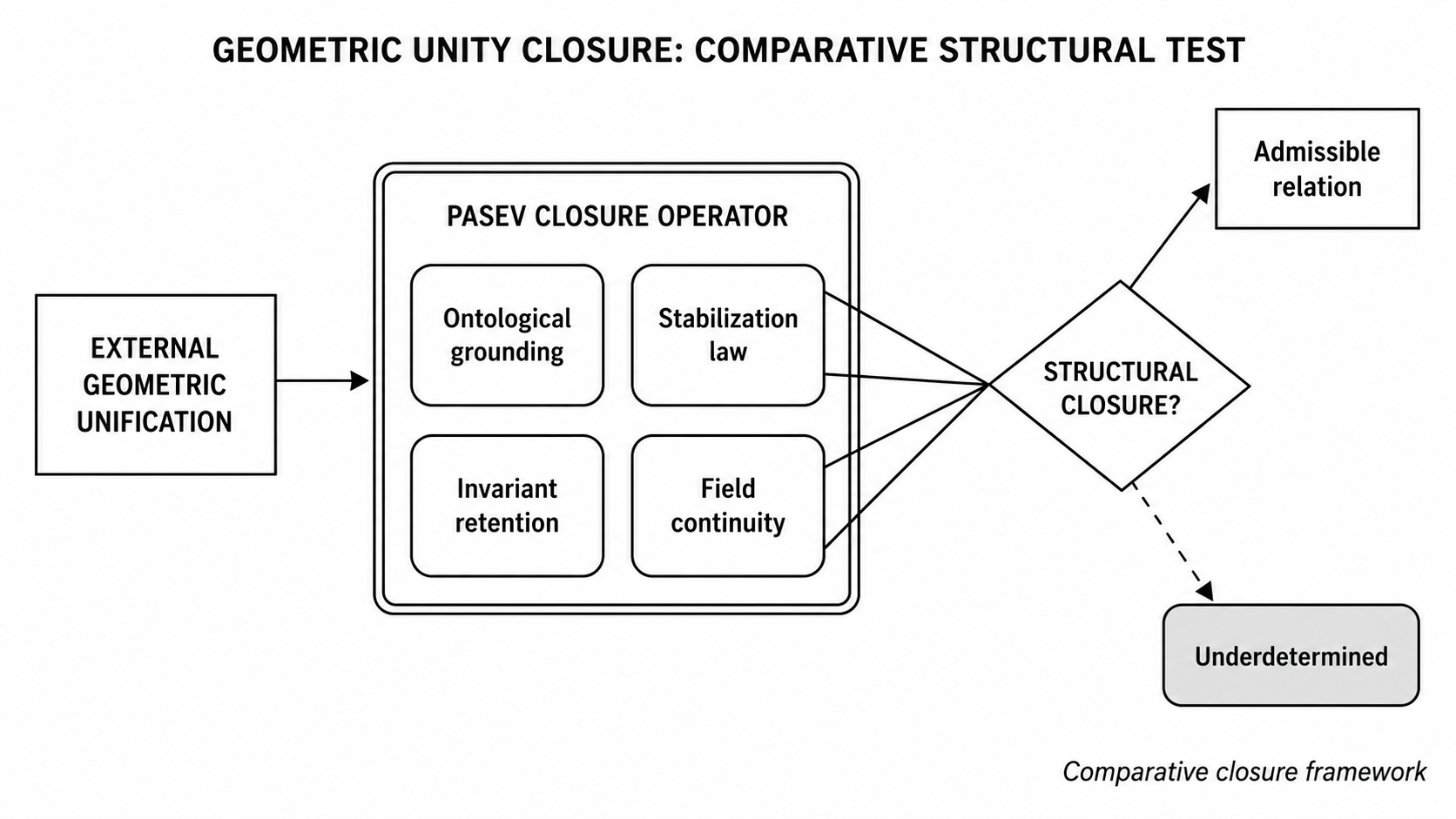
Universum and Omniversum
Universum is the deployable coherent knowledge architecture: canon, library, runtime, and civilization substrate. Omniversum is the meta-canonical open closure horizon and should not be used as the everyday public distribution label.
Public status boundary. This page is part of an authorial public research corpus. It may contain original frameworks, formalization targets, manuscripts, public archive records, implementation designs, and source routes. It does not assert accepted proof, peer review, experimental validation, institutional endorsement, legal certification, or global deployment unless that evidence is explicitly provided.
Relation to SFR
This page is one node in the Science of Fabric Reality. It should be read through the shared grammar of relation, invariant, trace, observer, closure, and boundary.
Core primitives
| Primitive | Working meaning |
|---|---|
| Structure | the organized carrier of relations. |
| Relation | lawful connection between distinguishable elements. |
| Invariant | preserved feature under admissible transformation. |
| Trace | inspectable record of transformation. |
| Observer | context of measurement, approval, interpretation, or state selection. |
| Boundary | claim status and domain of validity. |
| Failure mode | the condition under which the model breaks or must be revised. |
Formalization targets
- Define objects and morphisms.
- Define admissible transformations.
- State invariants and preservation obligations.
- Declare trace functions and observer context.
- Build lemma dependency graph.
- Identify domain restrictions and counterexample classes.
- Route mathematical claims to Lean/HoTT/Coq or proof-paper development.
- Route physics claims to simulation, observable, and falsifiability registry.
Failure modes
| Failure | Public risk | Required correction |
|---|---|---|
| Undefined terms | reader cannot evaluate claim | add glossary and symbol table. |
| Unsupported strength | overclaim | downgrade to proposed framework or formalization target. |
| Missing review route | no scientific pathway | add proof, simulation, or falsifiability target. |
| Media substitution | video treated as validation | mark videos as exposition only. |
| Source drift | record cannot be traced | add source note and registry entry. |
Internal links
graph TD
A[Universum and Omniversum] --> B[SFR]
B --> C[Invariant Engineering]
A --> D[Formalization Targets]
A --> E[Review Gateway]
A --> F["Publications / Media"]
Review Path
Every serious reader may review this page through five gates:
- Definition gate — terms, symbols, and scope must be defined.
- Boundary gate — the claim must be marked as accepted science, interpretation, proposed framework, formalization target, public record, operational design, software prototype, or strategic vision.
- Source gate — references, manuscripts, videos, code, datasets, or source notes must be traceable.
- Formalization gate — mathematical claims should be reducible to assumptions, definitions, lemmas, theorem statements, and proof obligations.
- Falsifiability / implementation gate — physics claims need observables and failure conditions; software claims need implementation scope and reproducible evidence.
Related: Public Review Gateway, Formalization Targets, Publications, Media.
Visual Directives
- Hero figure: restrained, institution-grade diagram; no mystical or triumphalist imagery.
- Diagram style: lattice, graph, archive spine, proof ladder, invariant registry, or source-route map.
- Caption rule: every figure must say whether it is a conceptual model, formalization target, source map, or implemented software feature.
- Card layer: use compact cards for definition, status, primitives, review path, failure modes, and source route.
Definitions
- Universum: The bounded, coherent domain of observable invariant structures.
- Omniversum: The theoretical superset of all mathematically possible fabric configurations, bounded only by formal logical consistency.
Failure Modes
Models attempting to map the Omniversum often encounter unresolvable paradoxes due to the breakdown of local trace invariants. These limits represent fundamental constraints on observer capacity.