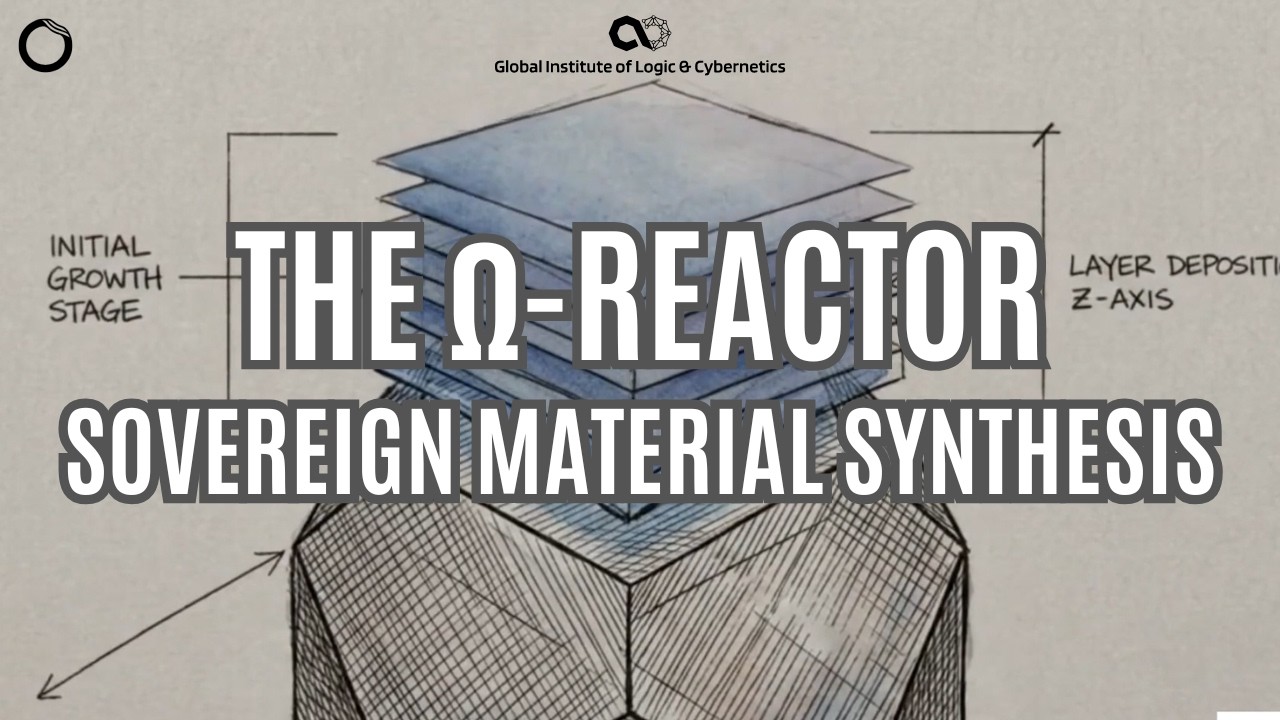
Professional engineering architectures governing thermodynamic conservation, resource distribution, and mechanical state conversion.
Spine Position
Upstream: Applied Fabrics Domain Atlas → Digital Fabrica Theory
This node: Energy, Industrial & Material Fabric (/05-fabrica/fabrics/energy-industrial-material)
Downstream: Citizen Solar Substrate, MPR-Sigma-1, Electrostatic Torque
Validation boundary: Physical engineering and thermodynamic models; requires independent laboratory replication and electrical safety certification.
Public status boundary. This page is part of an authorial public systems architecture corpus. It formalizes theoretical models of energy routing, materials interaction, and thermodynamic constraints. It does not assert certified energy generation, operational reactor readiness, patented hardware production, or utility grid deployment unless verified by explicit empirical commissioning logs.
I. Domain Mandate & Industrial Problem Space
The orchestration of heavy energy generation, high-precision manufacturing, and autonomous industrial supply chains demands absolute structural integrity. When physical logistics and energy networks drift from mathematical conservation bounds, systemic failures such as cascading grid blackouts, thermal runaway, and supply desynchronization occur.
The Energy, Industrial & Material Fabric provides the systems-engineering bridge between fundamental physics invariants and deployed industrial topologies:
graph TD
A[Raw Energy / Material State] --> B[Thermodynamic Invariant Filter]
B --> C{Conservation Bounds Satisfied?}
C -- Yes --> D[Optimal Expander Graph Routing]
C -- No --> E[Containment & Damping Action]
D --> F[Deterministic Telemetry Ledger]
E --> G[Operator Safety Protocol]
II. Upstream Theory Derivation
This applied fabric derives directly from the public theoretical spine:
- Science of Fabric Reality (SFR): Provides the relational and invariant calculus governing continuous systems.
- Fractal Quantum Field Theory (FQFT): Supplies the continuum field hypothesis and energy-matter interaction models.
- Digital Fabrica Theory (DFT): Translates continuum fields into discrete, computable network graphs.
- Applied Fabric (
): Localizes the architecture to physical machinery, thermal cycles, and power grids.
III. Formal Transformation Kernel
At the formal systems level, the Energy, Industrial & Material Fabric is defined as a 5-tuple:
where:
| Symbol | Systems Component | Operational Role |
|---|---|---|
| Material / Medium State | Physical state variables, density matrices, and material constants. | |
| Energy Field Context | Voltage, thermal flux, electromagnetic field tensors, and power flows. | |
| Control & Constraint Layer | Actuator policies, feedback damping controllers, and valve sentinels. | |
| Thermodynamic Boundary | Conservation of energy ( | |
| Validation Pathway | Standardized measurement protocols, calorimetric assays, and safety proofs. |
IV. Domain Architecture Map & Expander Routing
Systems deployed under this category utilize spectral expander graphs for high-resilience physical routing:
V. Validation & Falsification Matrix
| Sub-Domain | Testable Invariant | Falsification Criteria |
|---|---|---|
| Grid Power Routing | Frequency stability ( | Uncontrolled frequency excursions or untracked harmonic distortion |
| Thermal Dissipation | Boundary temperature within designed safe operating envelope | Localized overheating exceeding materials threshold |
| Mechanical Torque | Angular momentum conservation across coupled transmission stages | Mechanical torque drift exceeding calibrated friction losses |
| Materials Integrity | Structural stress tensors within linear elastic deformation bounds | Micro-fracture propagation or plastic deformation under rated loads |
VI. Canonical Continuation Pathways
| Direction | Target Node | Route | Focus / Purpose |
|---|---|---|---|
| Upstream | Applied Fabrics Atlas | /05-fabrica/fabrics/index | Full taxonomy of domain-specific applied fabrics |
| Sibling Substrate | Citizen Solar Substrate | /05-fabrica/citizen-solar | Decentralized photovoltaic and microgrid architecture |
| Downstream Applied | MPR-Sigma-1 Architecture | /05-fabrica/fabrics/mpr-sigma-1 | Applied mechanical power & torque modeling |
| Downstream Applied | Electrostatic Torque | /05-fabrica/fabrics/electrostatic-torque | Field-mediated torque transfer mechanisms |