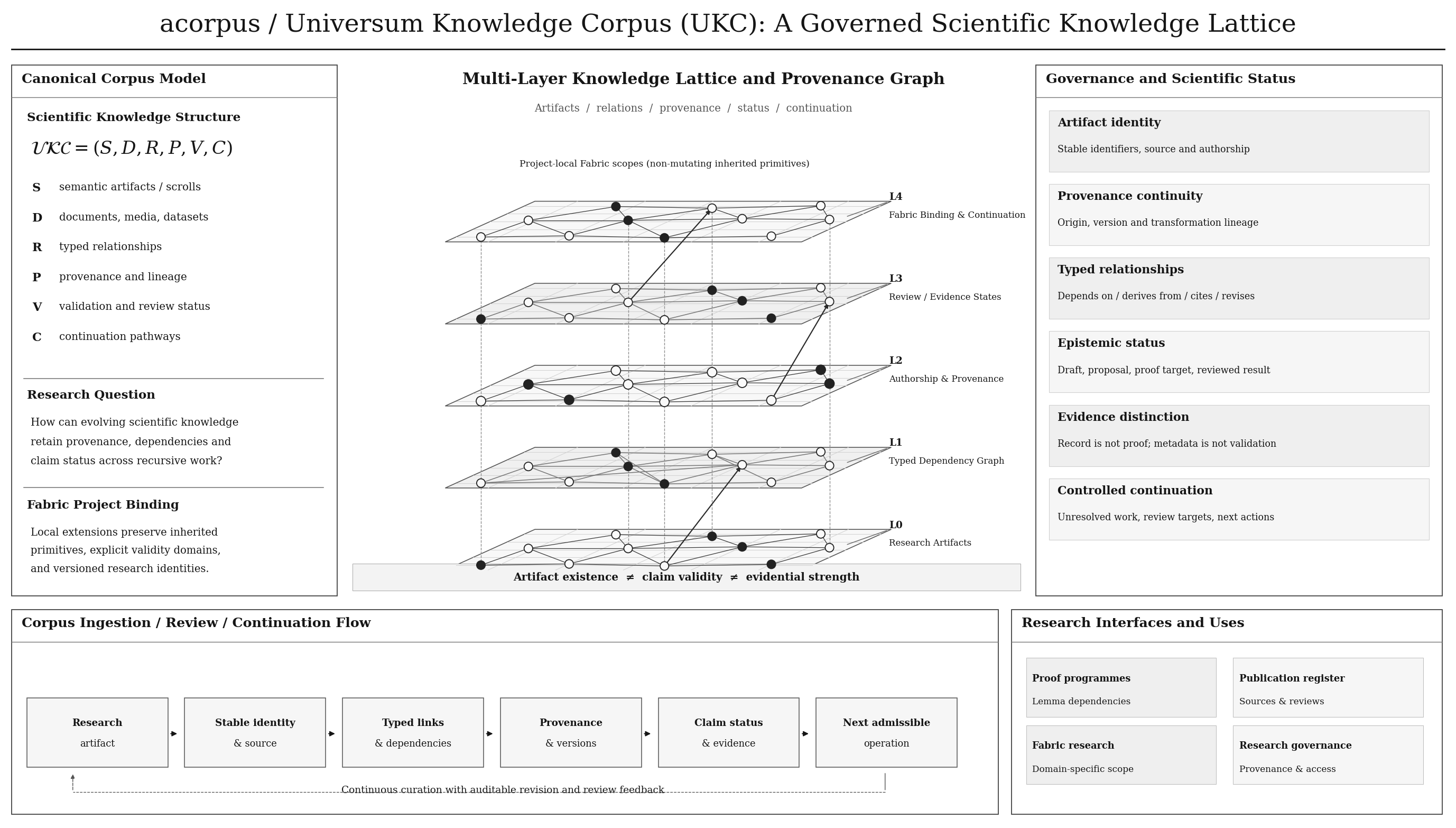
Constitutional Demarcation: A Research Fabric is a bounded epistemological architecture. Structural formulation, digital execution, and proof-assistant replay declare local invariants; they do not constitute unverified physical validation.
Research Question
How can a large, evolving research programme preserve knowledge relationships, provenance, scientific status and valid continuation without degrading into a flat repository of disconnected files?
Scientific Basis
The SFR defines the Universum Knowledge Corpus as a structured corpus-space rather than a bibliography or archive. Its objects are organized by dependency, authorship, provenance, status, domain, relation and admissible continuation.
A compact corpus model is:
where
The acorpus layer extends this into the web/project-binding model used for Research Fabrics: each Fabric carries local extensions and validity constraints without mutating inherited constitutional primitives.
Architecture
- artifact layer — papers, manuscripts, datasets, media, code, proof records and institutional documents;
- corpus lattice — typed relationships among artifacts and theories;
- provenance layer — authorship, origin, lineage and transformation history;
- status layer — published, draft, proposal, proof target, implementation, validation state;
- dependency layer — what a record relies on and what relies on it;
- continuation layer — unresolved work, review targets and next admissible operations;
- Fabric bindings — bounded project-local scopes, interfaces and evidence states.
Core Invariants
- authorship must remain preserved;
- provenance must remain recoverable;
- status must not be flattened;
- dependency relations must remain explicit;
- local Fabric extensions must not silently mutate inherited primitives;
- continuation must preserve version lineage.
Validity Domain & Public Status Boundary
A corpus record is not evidence merely because it is indexed. acorpus/UKC must preserve the distinction between existence of an artifact, status of a claim, and strength of supporting evidence.
Evidence & Status
Architecture defined and actively used as knowledge/corpus methodology. Implementation maturity may differ across storage, indexing, provenance and execution components.
Research / Implementation Path
- formalize the canonical Fabric record;
- assign stable identifiers and relationship types;
- connect publication records and source artifacts;
- preserve immutable provenance fields;
- separate public metadata from private research state;
- build graph views for dependencies and related Fabrics.
Publications & Primary Materials
No Zenodo publication in the current publication registry is assigned directly to UKC/acorpus.
Related Fabrics
- DFT
- CodexStation
- Recursive Intelligence
- Quantum Consensus
- Trace Reciprocity
- New Millennium Frontier
