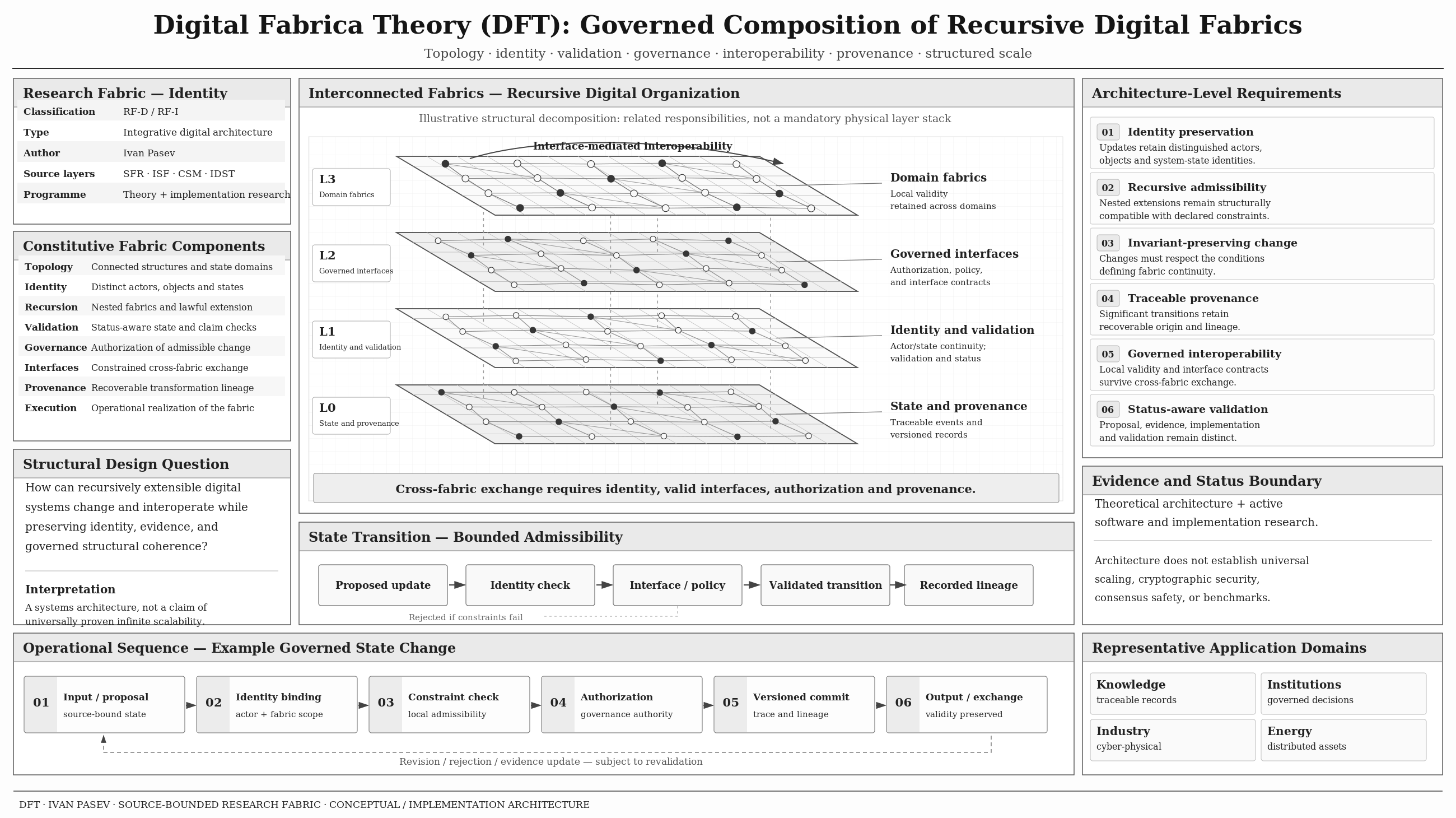
Constitutional Demarcation: A Research Fabric is a bounded epistemological architecture. Structural formulation, digital execution, and proof-assistant replay declare local invariants; they do not constitute unverified physical validation.
Research Question
What architecture is required for digital systems to scale, interoperate, govern change, preserve identity and remain structurally coherent across recursive extension?
Scientific Basis
Digital Fabrica Theory is positioned as a high-order systems synthesis. It inherits fabric primacy and relational structure from the foundational layers, stabilized continuation from ISF/CSM, recursive admissibility from IDST, and explicit preservation constraints from Invariant Engineering. Its role is not to replace these layers, but to make them infrastructural.
DFT therefore treats digital systems as lawfully woven structures rather than as independent applications, ledgers, databases or protocols later connected by ad hoc interfaces.
Architecture
A DFT system can be represented as a governed composition of:
- topology — how system components and state domains are connected;
- identity — how actors, objects and system components remain distinguishable across change;
- recursive organization — how nested fabrics and sub-fabrics extend without losing admissibility;
- validation — how state transitions and claims are checked;
- governance — how permissible changes and decisions are authorized;
- interoperability — how distinct fabrics exchange state without erasing their local constraints;
- provenance — how origin, lineage and transformation history remain visible;
- economic/resource logic — where relevant, how value and resource flows are constrained by the fabric;
- execution — how declared architecture becomes operational while preserving its invariants.
The central architectural rule is that a fabric is not merely a graph of connections. Its relations are governed by explicit structural conditions.
Core Invariants
The public DFT page should preserve at least these architecture-level invariants:
- Identity preservation — transformations must not silently erase the identity of actors, objects or system state.
- Recursive admissibility — extension into nested or larger structures must remain structurally valid.
- Invariant-preserving change — updates must preserve the conditions that define the system's lawful identity.
- Traceable provenance — significant state changes require recoverable origin and lineage.
- Governed interoperability — cross-fabric exchange must preserve local validity and interface constraints.
- Status-aware validation — evidence, proposals, implementations and validated results must not be collapsed into one undifferentiated state.
Validity Domain & Public Status Boundary
DFT is an original systems-theoretical and architectural framework. Its existence as a developed architecture does not imply that every proposed DFT mechanism is implemented, benchmarked, standardized, experimentally validated or superior to established distributed-system architectures.
Specific cryptographic, consensus, economic, scaling or infrastructure claims should be stated only at the evidence level supported by their dedicated implementation or evaluation records.
Evidence & Status
Current registry state: mature theoretical architecture with active implementation research.
Evidence currently includes formal architecture, software/kernel development, publication records, system specifications and applied Fabric projects. Individual application claims require their own evidence.
Research / Implementation Path
- maintain a canonical invariant and interface specification;
- bind theories to executable kernels only where operational correspondence is defined;
- implement reference fabrics with explicit testable contracts;
- benchmark interoperability, provenance and state-transition behaviour;
- separate theoretical guarantees from engineering observations;
- document failure conditions and implementation limits;
- maintain public compatibility between the theory layer and implementation layer.
Publications & Primary Materials
- Digital Fabrica Theory: Mathematical Logic and Core Foundations — Zenodo, 2025
- Infinite Core Scaling: A Minimum Viable Model for Logarithmic Growth in Digital Fabrica Theory — Zenodo, 2025
- Digital Fabrica Theory: A Formal Framework for Infinite-Scale, Ethically Governed, Quantum-Secure Digital Infrastructure — Zenodo, 2026
Related Fabrics
- Principia Fabrica
- REALICA / TFR
- Infinite & Complete Stabilization
- IDST
- Invariant Engineering
- Recursive Intelligence
- Observer Monad
- Quantum Consensus
- acorpus / UKC
- CodexStation
- Industry 5.0 Industrial Fabric
