Constitutional Demarcation: A Research Fabric is a bounded epistemological architecture. Structural formulation, digital execution, and proof-assistant replay declare local invariants; they do not constitute unverified physical validation.
Research / Engineering Question
How can heterogeneous distributed-energy resources be coordinated as a community-scale energy fabric while preserving asset visibility, grid constraints, dispatch accountability and local operational boundaries?
Scientific & Engineering Basis
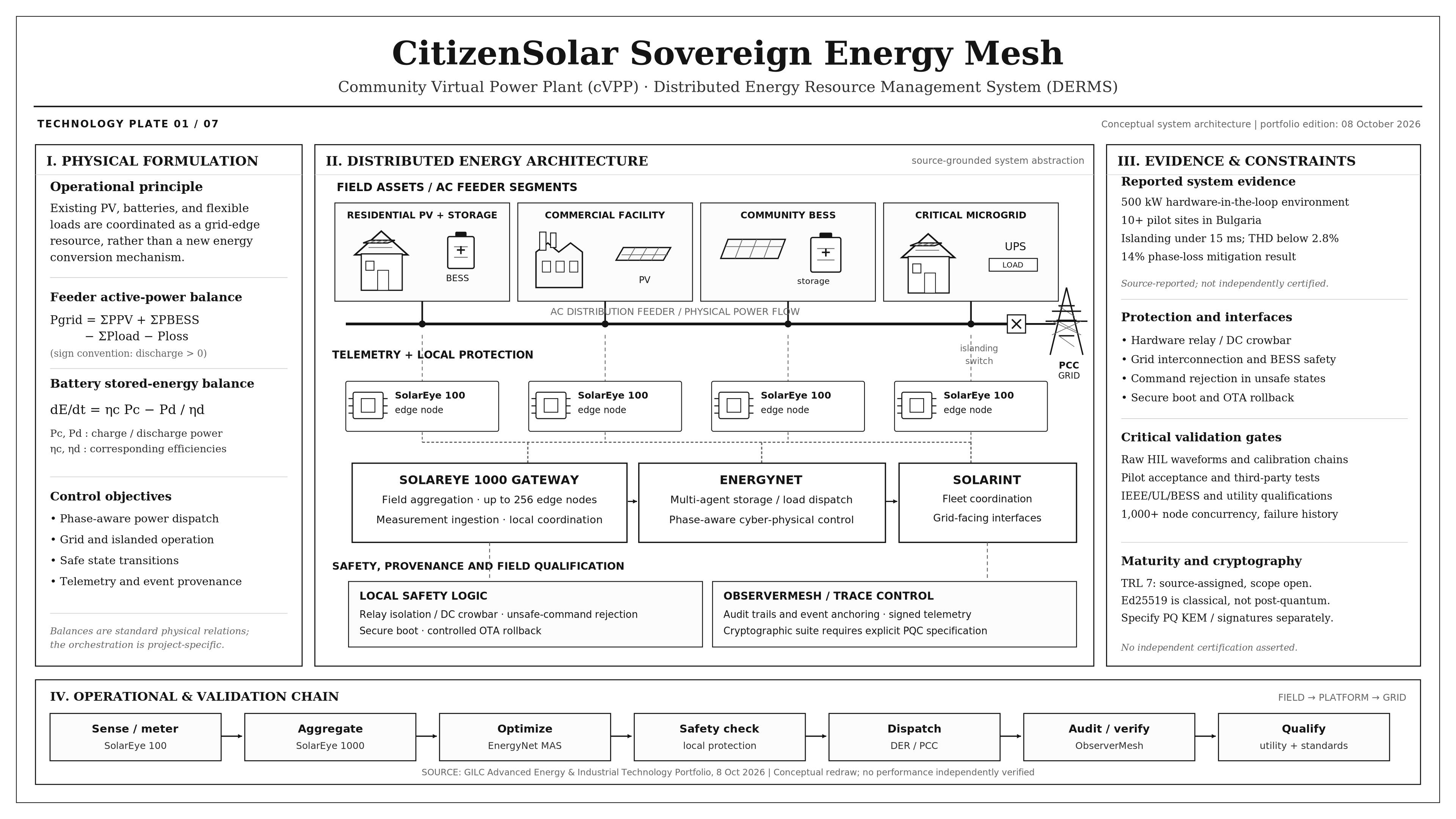
The CitizenSolar project material defines a distributed-energy stack centered on a community Virtual Power Plant (cVPP) and Distributed Energy Resource Management System (DERMS). The architecture combines generation, storage, loads, communication, monitoring and control rather than treating individual DER assets as isolated installations.
Legacy project materials identify three principal technology lines:
- EnergyEye — field monitoring / gateway layer;
- EnergyInt / SolarINT — monitoring, analytics and control interface;
- EnergyNet — decentralized energy-management / multi-agent coordination layer.
The architecture also includes BESS, EV/charging integration, IoT/PLC control, telemetry and communication interfaces.
Architecture
- DER asset layer — rooftop/utility PV, storage, controllable loads, EV charging and other local resources.
- Site gateway layer — monitoring, metering, connectivity and local control.
- Community microgrid layer — bounded local energy systems with islanding/critical-load capability where designed.
- DERMS / cVPP coordination layer — aggregation, optimization, dispatch and grid-service coordination.
- Grid interface — interconnection, constraints, market or dispatch signals and settlement records.
- Data / analytics layer — monitoring, forecasting, anomaly identification and operational optimization.
- Governance / provenance layer — asset identity, control authority, event history and auditable state changes.
Core Invariants
- asset identity remains explicit;
- command authority is bounded by declared ownership and grid roles;
- physical grid constraints dominate software optimization;
- measurement provenance is preserved;
- dispatch actions remain traceable;
- local resilience/islanding claims require site-specific validation;
- economic optimization must not silently override electrical safety or interconnection constraints.
Evidence & Status
The available project record supports a developed architecture, legacy MVP work and pilot-oriented engineering. Earlier project material records EnergyNet monitoring at a Green Cross pilot and identifies additional potential EU/US deployment grounds.
Where later portfolio material assigns a TRL or maturity level, it should be presented as programme/dossier-declared maturity, not as independent certification.
Public Status Boundary
CitizenSolar is not presented as a universally deployed VPP network or as proof of grid-performance improvement at arbitrary scale. Site performance, savings, flexibility, resilience and market value are deployment-specific and require measured evidence.
Research / Implementation Path
- canonicalize the current DER/cVPP reference architecture;
- bind site telemetry to verified asset identities;
- define control and fail-safe envelopes;
- build interoperable DER adapters;
- validate forecasting and dispatch against measured baselines;
- quantify flexibility, losses, reliability and economics per pilot;
- document grid-code and market interfaces per jurisdiction.
Publications & Primary Materials
No directly matched Zenodo publication for CitizenSolar appears in the current publication registry.
Project materials
- CitizenSolar Energy Project Proposal (Draft) — internal project source.
- GILC video: Indestructible Infrastructure: The DFT Energy Fabric Rollout — supporting media; not independent validation.
Related Fabrics
- DFT
- Industry 5.0 Industrial Fabric
- Invariant Engineering
- SolarEye
- SolarINT
- ObserverMesh
- ScrollWitness
