Skip to content
EPISTEMIC DEMARCATION // Tier 3 (Execution Platform)
Inspect Results Ledger →

Constitutional Demarcation: A Research Fabric is a bounded epistemological architecture. Structural formulation, digital execution, and proof-assistant replay declare local invariants; they do not constitute unverified physical validation.

Research Question ​

How can complex scientific and institutional knowledge operations be executed without losing project identity, provenance, reasoning boundaries, validation state or controlled continuation?

Scientific Basis ​

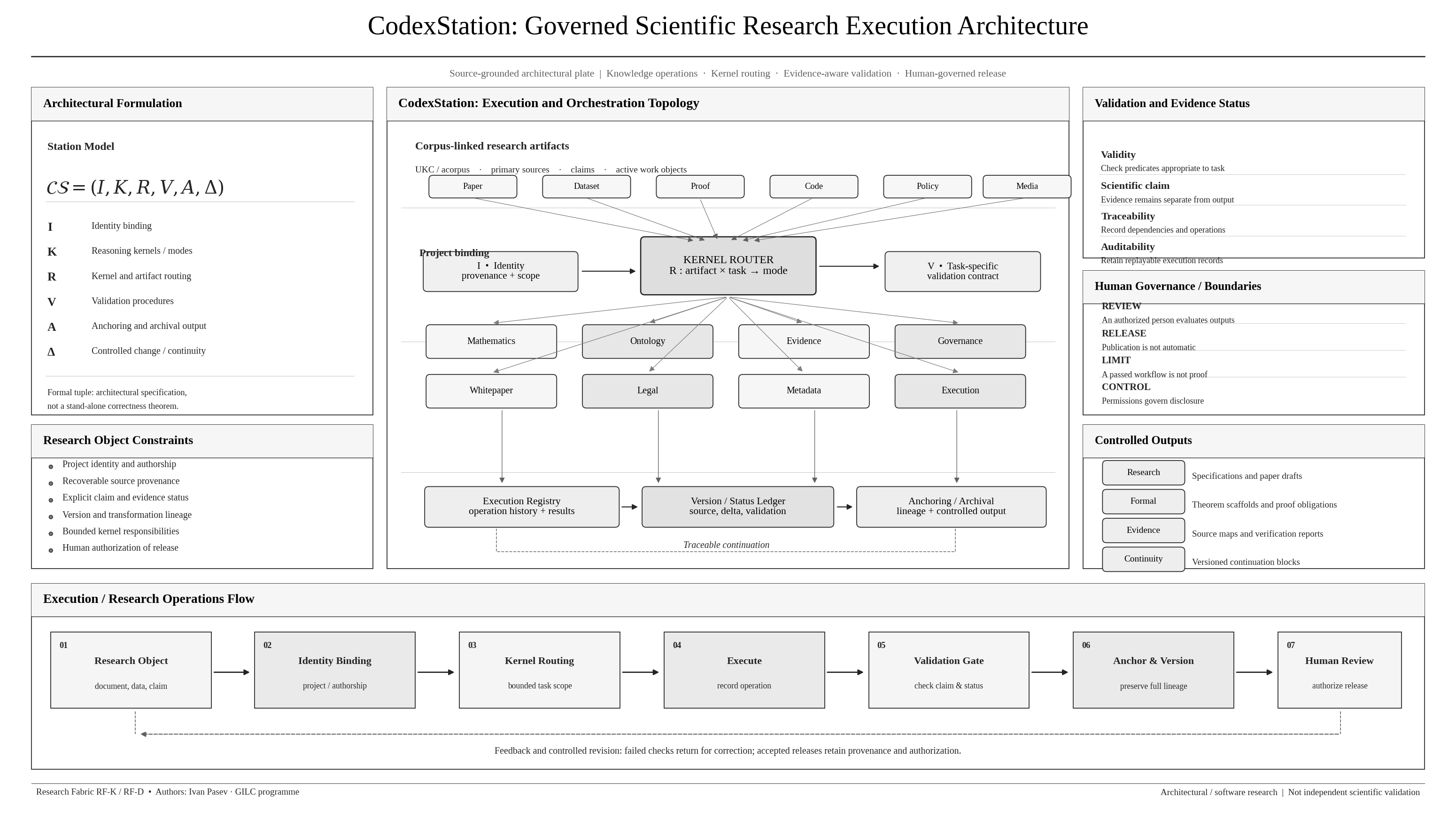
SFR positions CodexStation as the execution and orchestration layer of the GILC/DFT knowledge architecture. UKC preserves and orders knowledge; CodexStation acts on that corpus through governed operations.

A compact station model is:

CS=(I,K,R,V,A,Δ)

where I is identity binding, K kernels/reasoning modes, R routing rules, V validation procedures, A anchoring/archival output, and Δ controlled change.

Architecture ​

  • identity binding — project, authorship, institutional frame and claim boundary;
  • kernel routing — task-specific reasoning modes;
  • state/version control — explicit transformation history;
  • validation gates — checks matched to the object and claim type;
  • execution registry — record of operations and outputs;
  • output preparation — documents, specifications, theorem scaffolds, evidence maps and continuation blocks;
  • human authorization — review and release remain governed rather than automatically assumed.

Core Invariants ​

  • project identity;
  • authorship and provenance;
  • bounded kernel scope;
  • status/claim separation;
  • version lineage;
  • auditable execution;
  • human-governed release.

Validity Domain & Public Status Boundary ​

CodexStation is an execution architecture. It does not confer scientific truth on outputs, replace peer review, establish autonomous theorem proving, or guarantee correctness merely because an operation passed through the station.

Its purpose is controlled execution, not automatic epistemic authority.

Evidence & Status ​

Active architecture and software-oriented development. Some components exist as kernels, routing systems, registries and research workflows; maturity should be stated per component rather than generalized across the whole station.

Research / Implementation Path ​

  • stabilize canonical object schemas;
  • formalize kernel contracts;
  • implement provenance-preserving execution records;
  • connect acorpus/UKC objects directly to operations;
  • implement evidence/status gates;
  • test replayability and deterministic workflow segments;
  • develop public/private disclosure boundaries.

Publications & Primary Materials ​

No Zenodo publication in the current publication registry is assigned directly to CodexStation.

  • acorpus / UKC
  • DFT
  • Recursive Intelligence
  • KBI / Reasoning Fabric
  • Quantum Consensus
  • Invariant Engineering
Primary Source01_LIBRARY_42/codexstation.md
Source SHA-256ac38be72ca8fa570b7fab3f2b87fe103d95a98dbea60f3c95c33c16b68e79069
TRWM BridgeRF-019__codexstation__TRWM_BRIDGE_v1.3.md
Corpus StatusSOURCE_GROUNDED_DRAFT_NOT_RELEASED