Skip to content
EPISTEMIC DEMARCATION // Tier 4 (Laboratory Concept)
Inspect Results Ledger →

Constitutional Demarcation: A Research Fabric is a bounded epistemological architecture. Structural formulation, digital execution, and proof-assistant replay declare local invariants; they do not constitute unverified physical validation.

Research / Engineering Question ​

Can useful rotational torque be generated and controlled through a direct field-mediated actuator architecture with lower mechanical complexity than conventional motor-plus-gearbox systems?

Engineering Basis ​

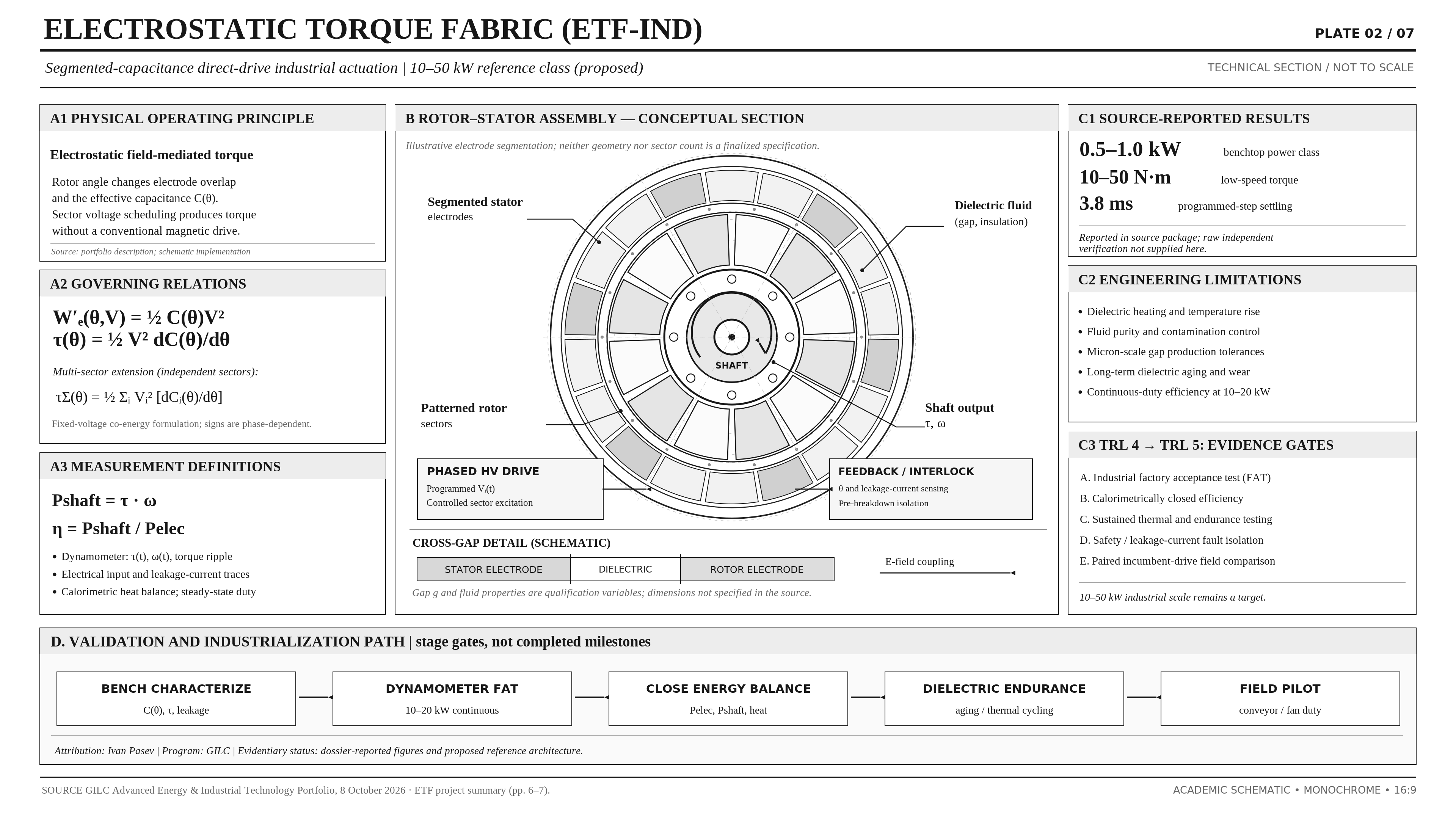
ETF is an actuation programme, not a new fundamental force claim. Its design concept uses patterned electrode structures, controlled electric fields and a dielectric / electrohydrodynamic working interface to create controllable mechanical torque.

The public media description presents the programme as an attempt to reduce reliance on heavy copper windings and mechanical gearing. Those are design objectives, not established universal performance advantages.

Architecture ​

  • electrode / field structure — patterned elements that establish the actuation field;
  • working medium / interaction gap — the region through which field stress is transferred;
  • rotor / mechanical output stage — converts distributed field forces into useful torque;
  • high-voltage drive electronics — generates and modulates actuation waveforms;
  • sensing layer — position, speed, torque, current/voltage, temperature and dielectric-state monitoring;
  • control layer — closed-loop torque/speed regulation;
  • safety envelope — dielectric breakdown, thermal, insulation, fluid/material compatibility and fault isolation.

Core Invariants ​

  1. torque claims must be tied to measured mechanical output;
  2. electrical input and losses must be separately measured;
  3. dielectric and insulation limits may not be exceeded by control optimization;
  4. thermal state must remain inside material limits;
  5. rotor state and commanded field state remain traceable;
  6. efficiency must be reported over explicit operating points, not as a generic property.

Evidence & Status ​

Current portfolio framing places ETF on a TRL 4 → 5 programme path. This is a programme maturity classification, not independent certification.

Public Status Boundary ​

ETF should not be described publicly as frictionless, lossless, or proven superior to conventional motors unless a specific test programme establishes those claims. The strongest current framing is a direct electrostatic torque research and actuation architecture with an explicit prototype-validation pathway.

Research / Implementation Path ​

  • freeze reference actuator geometry;
  • establish electrostatic and electrohydrodynamic models;
  • instrument electrical input, torque, speed and thermal behaviour;
  • map dielectric-breakdown and fault envelopes;
  • compare against conventional actuation baselines at matched duty points;
  • progress to an integrated prototype only after repeatable bench validation.

Publications & Primary Materials ​

No directly matched Zenodo publication for ETF appears in the current publication registry.

Supporting media ​

  • Electrostatic Torque Fabric: The End of Mechanical Complexity — GILC project video; descriptive project media, not validation evidence.
  • Industry 5.0 Industrial Fabric
  • DFT
  • Invariant Engineering
  • MPR-Σ1
Primary Source01_LIBRARY_42/etf.md
Source SHA-256cd5d5963036b85184eb37a0472a87c856a95660dd1bae39114077580c01c4595
TRWM BridgeRF-037__etf__TRWM_BRIDGE_v1.3.md
Corpus StatusSOURCE_GROUNDED_DRAFT_NOT_RELEASED