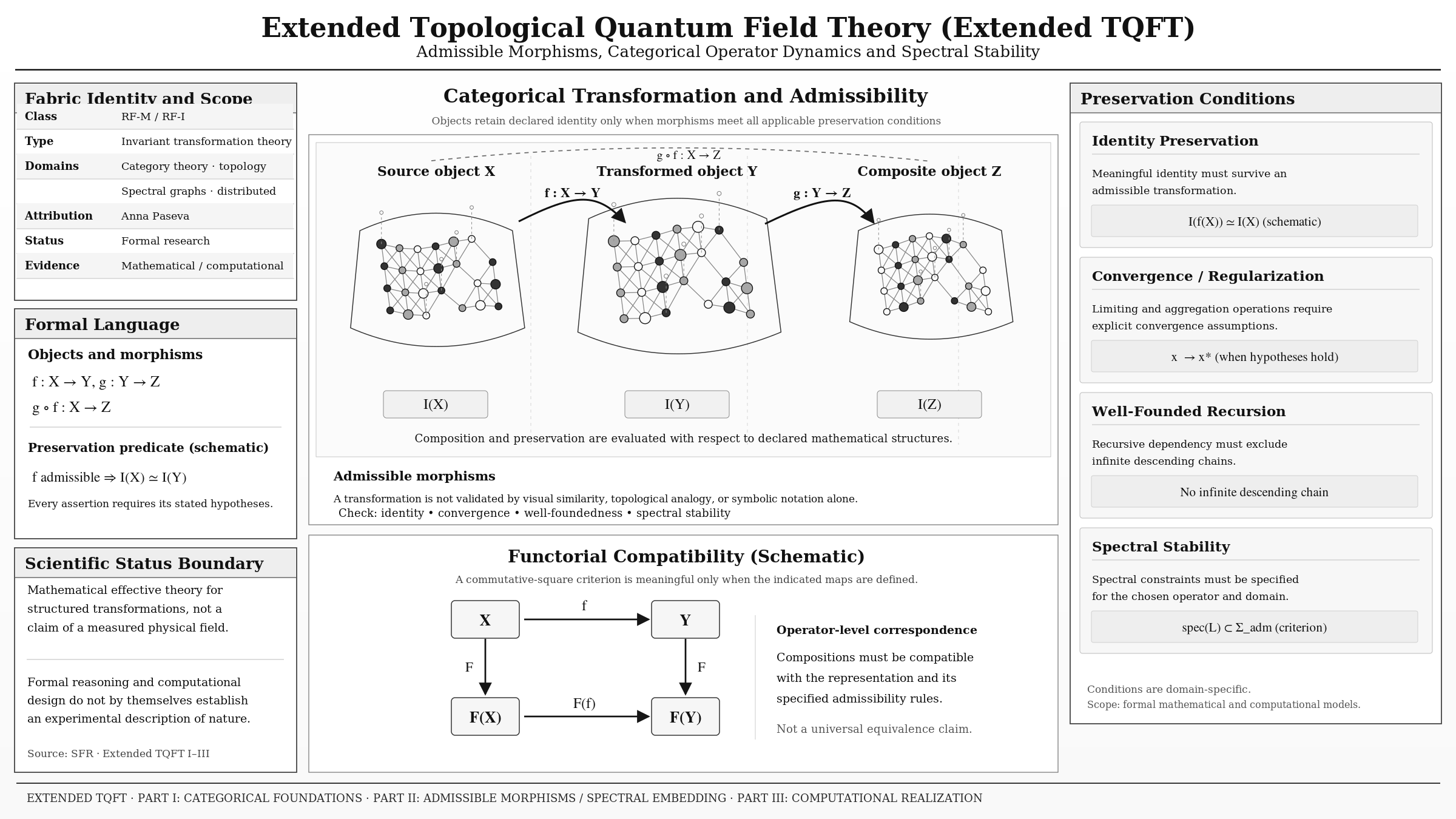
Constitutional Demarcation: A Research Fabric is a bounded epistemological architecture. Structural formulation, digital execution, and proof-assistant replay declare local invariants; they do not constitute unverified physical validation.
Research Question
When may a system transform without ceasing to be itself in the formal sense relevant to the model?
Scientific Basis
The SFR section explicitly distinguishes classical physical TQFT from Anna Paseva’s Extended TQFT. The latter is presented as a proposed mathematical effective theory for invariant computational structures, distributed networks, governance systems, regularized economies, and spectral-security architectures.
Architecture
The framework centers on admissible morphisms and four preservation requirements:
- invariant identity;
- convergence / regularization;
- well-founded recursion;
- spectral stability.
The manuscript series also develops operator dynamics, spectral embedding, a stability theorem structure, computational realization, and governance/economic applications.
Core Invariants
- identity preservation;
- convergence;
- well-foundedness;
- spectral stability.
These four conditions should remain central on the public page.
Validity Domain & Public Status Boundary
Do not present Extended TQFT as accepted physical quantum field theory or as a demonstrated description of the natural universe. Its current legitimacy is mathematical/formal and application-oriented.
Publications & Primary Materials
- Extended Topological Quantum Field Theory (Part I): Formal Foundations and Categorical Operator Dynamics
- Extended Topological Quantum Field Theory (Part II): Admissible Morphisms, Spectral Embedding, and The Master Theorem of Stability
- Extended Topological Quantum Field Theory (Part III): Computational Realization, Zeta Economics, and Invariant Governance
Related Fabrics
Invariant Engineering · IDST · DFT · Quantum Consensus · Trace Reciprocity
