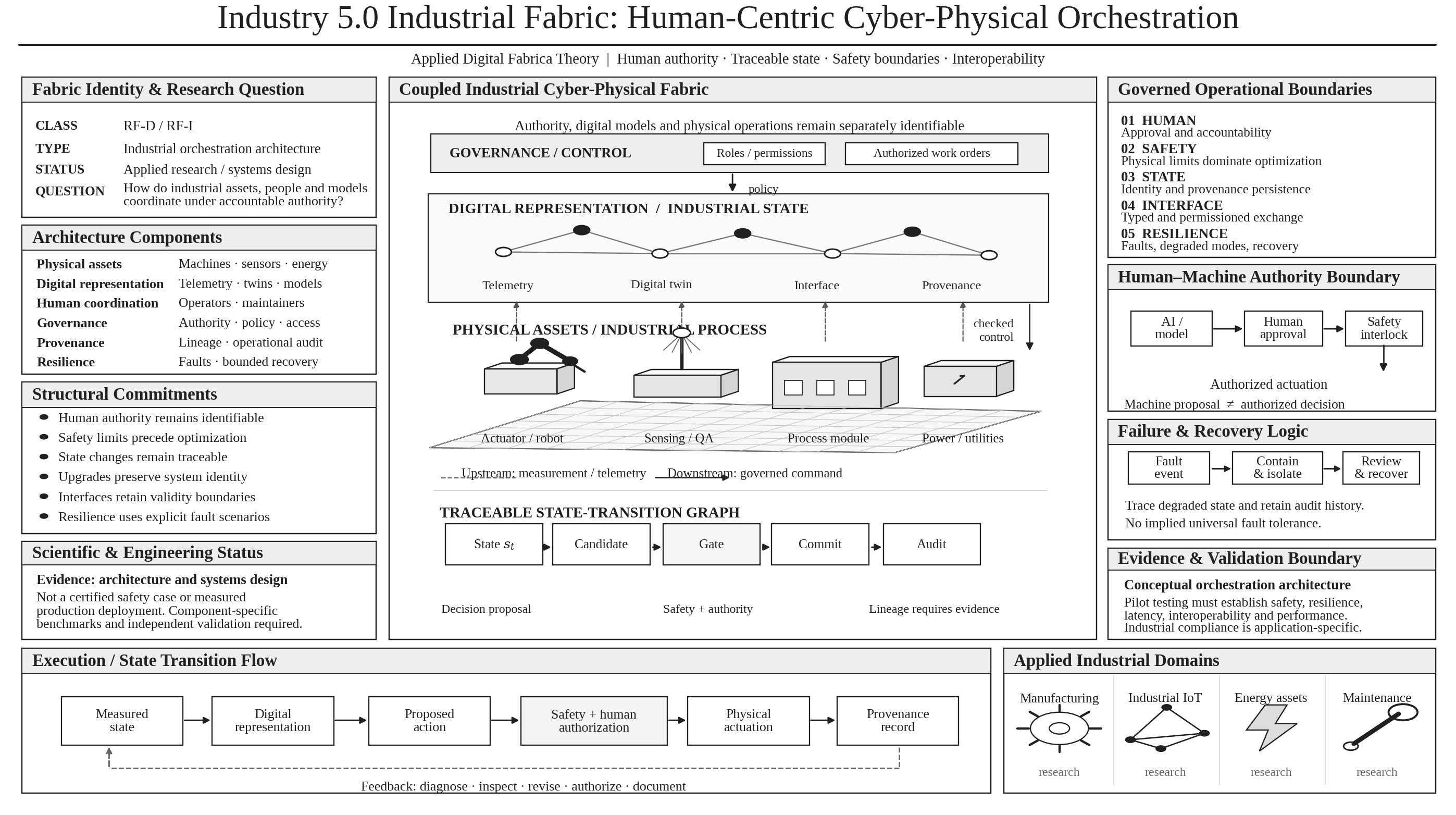
Constitutional Demarcation: A Research Fabric is a bounded epistemological architecture. Structural formulation, digital execution, and proof-assistant replay declare local invariants; they do not constitute unverified physical validation.
Research Question
How can industrial systems coordinate machines, digital twins, humans, governance and distributed infrastructure while preserving traceability, safety boundaries and system identity across change?
Scientific Basis
This Fabric is an applied DFT layer, not a foundational SFR theory. Its role is to translate fabric architecture into industrial cyber-physical coordination.
The current project corpus supports DFT integration with industrial/IoT, distributed infrastructure, human-facing interaction and governed system orchestration. The exact industrial implementation profile remains project-specific.
Architecture
- physical asset layer — machines, energy systems, sensors and industrial processes;
- digital representation layer — state models and digital twins where implemented;
- human coordination layer — operators, engineers, maintainers and decision-makers;
- governance layer — permissions, change control and safety boundaries;
- interoperability layer — interfaces among heterogeneous industrial systems;
- provenance layer — traceable operational and engineering state;
- resilience layer — bounded response to faults, degradation and changing conditions.
Core Invariants
- human authority and accountability remain identifiable;
- safety constraints cannot be silently overridden by optimization;
- operational state changes remain traceable;
- system identity persists across upgrades and component replacement;
- interfaces preserve declared validity boundaries;
- resilience is assessed through explicit failure conditions.
Validity Domain & Public Status Boundary
This page describes an applied research architecture. It does not establish certified industrial safety, regulatory compliance, production deployment, autonomous control authority or measured performance unless those are documented in a specific implementation.
Evidence & Status
Current status is architectural and systems-design oriented. The project corpus does not yet support one universal implementation maturity level for the whole Industrial Fabric.
Research / Implementation Path
- select a bounded industrial use case;
- define assets, state variables and safety invariants;
- build a traceable digital representation;
- define human and machine authority boundaries;
- implement interface and provenance contracts;
- benchmark resilience and operational performance;
- validate against applicable industrial standards.
Publications & Primary Materials
No Zenodo publication in the current publication registry is assigned directly to the Industry 5.0 Industrial Fabric.
Related Fabrics
- DFT
- Invariant Engineering
- Quantum Consensus
- CodexStation
- CitizenSolar
- ETF
- MPR-Σ1
- TOPRI
