Skip to content
EPISTEMIC DEMARCATION // Tier 5 (Resonance Confinement)
Inspect Results Ledger →

Constitutional Demarcation: A Research Fabric is a bounded epistemological architecture. Structural formulation, digital execution, and proof-assistant replay declare local invariants; they do not constitute unverified physical validation.

Research / Engineering Question ​

Can a high-Q, externally pumped nonlinear optical cavity be engineered so that double resonance, quasi-phase matching, low-loss mid-infrared confinement, thermal stability and controlled power extraction remain simultaneously satisfied in a reproducible device, and can that device then be progressed through measured optical-to-electrical conversion before any larger modular energy architecture is claimed?

Scientific & Engineering Basis ​

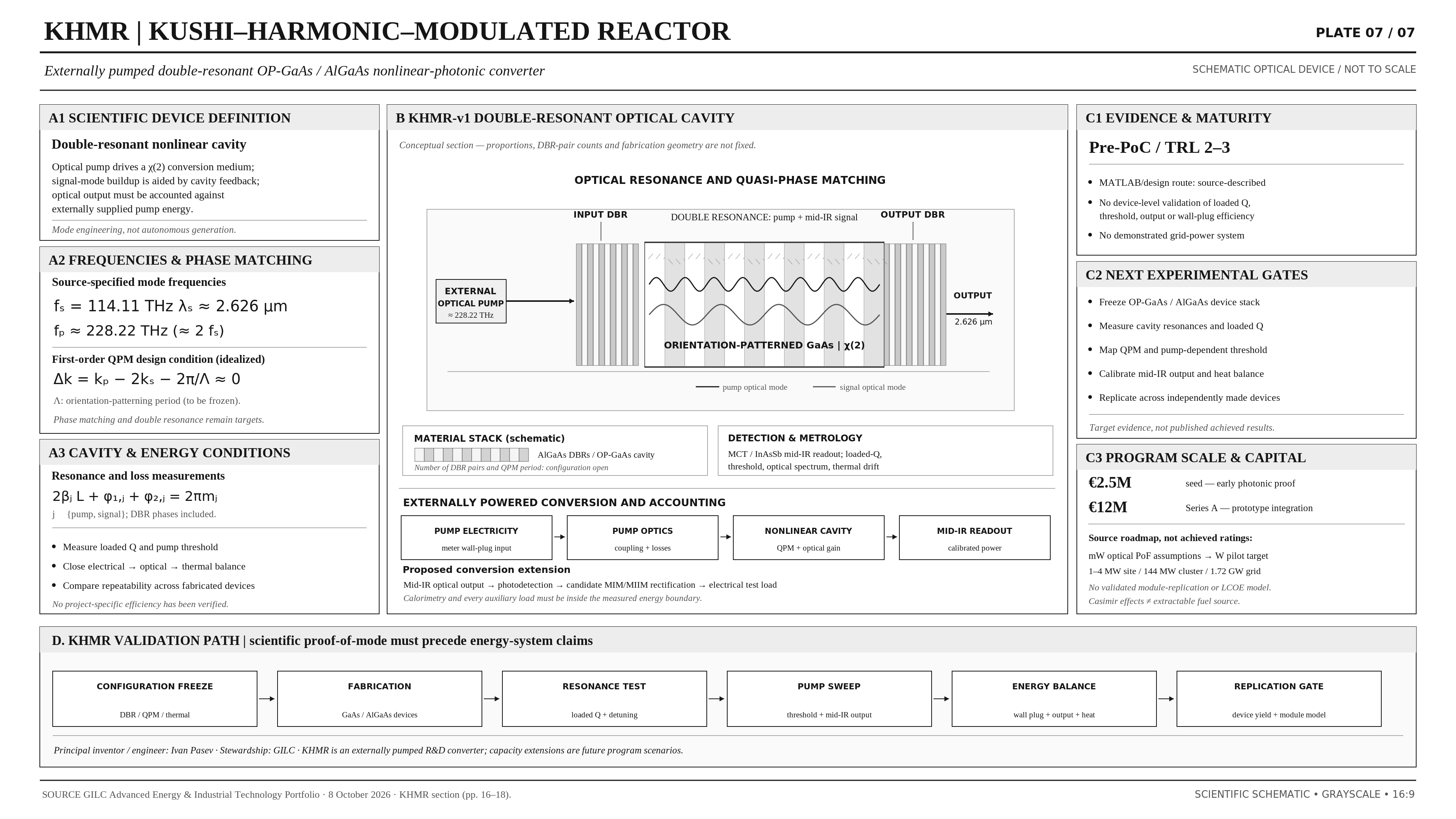
The KHMR reference architecture is best treated as a nonlinear-photonic energy converter, not as a free-energy or perpetual-motion system. The source package explicitly states that useful work must remain traceable to an external non-equilibrium pump. Vacuum/Casimir language is therefore restricted to mode-shaping, boundary-condition and spectral-engineering roles rather than treated as a fuel source.

The current KHMR-v1 baseline centers on a degenerate optical-parametric architecture with:

  • signal / harmonic mode near 114.11 THz (approximately 2.626 μm);
  • pump mode near 228.22 THz (approximately 1.313 μm);
  • orientation-patterned GaAs (OP-GaAs) as the nonlinear medium;
  • GaAs / AlGaAs distributed Bragg reflectors (DBRs) for high-Q vertical confinement;
  • quasi-phase matching (QPM) to minimize effective phase mismatch;
  • joint optimization of QPM period, cavity length, modal overlap and signal/pump resonance;
  • thermal, mechanical and frequency stabilization sufficient to remain inside the cavity linewidth.

The source material includes analytical scaling relations, MATLAB optimization logic, device-fabrication specifications, DBR/micropillar metrology requirements and proposed optical-readout / rectification pathways. These constitute an engineering and experimental programme definition; they are not equivalent to project-specific device validation.

Architecture ​

A diligence-grade KHMR reference stack contains:

  1. Pump / drive layer — externally supplied optical energy and pump-frequency control.
  2. Double-resonant cavity — simultaneous confinement of the signal and pump modes.
  3. Nonlinear OP-GaAs core — χ(2) interaction region with orientation-patterned QPM.
  4. GaAs / AlGaAs DBR system — high-reflectivity confinement plus a controlled output-coupling path.
  5. Thermal / mechanical stabilization — temperature control, alignment, vibration suppression and cavity-locking instrumentation.
  6. Optical extraction and diagnostics — direct measurement of threshold, spectrum, linewidth, output power, Q and conversion behaviour.
  7. Optical-to-electrical interface — first-stage photodetection/readout, followed by later MIM/MIIM rectenna research where justified.
  8. Power conditioning — DC regulation / inversion only after a measured electrical output boundary exists.
  9. Modular replication layer — future aggregation into larger modules or clusters only after one-device and multi-device evidence closure.

Core Invariants / Evidence Firewalls ​

  1. pump energy ≠ generated useful energy — the full wall-plug energy boundary must be closed;
  2. vacuum/Casimir mode engineering ≠ vacuum fuel;
  3. analytical threshold prediction ≠ measured oscillation threshold;
  4. simulated Q / resonance ≠ measured loaded Q / resonance;
  5. optical output ≠ electrical output — conversion stages are reported separately;
  6. single-device operation ≠ modular scale-up;
  7. fabrication compatibility ≠ fabrication yield — yield must be measured on project-specific wafers/devices;
  8. future MW/GW roadmap values ≠ demonstrated device capacity;
  9. regulatory positioning ≠ legal classification or approval.

These boundaries should remain explicit in all public website material.

Reference Technical Baseline ​

The current source package repeatedly uses the following reference values and targets:

ParameterSource-defined reference
Signal frequency114.11 THz
Signal wavelength≈ 2.626 μm
Pump frequency≈ 228.22 THz
Pump wavelength≈ 1.313 μm
Nonlinear materialOP-GaAs
Reflector platformGaAs / AlGaAs DBRs
Cavity quality-factor objectivehigh-Q; source design range approximately 10^5–10^6
Thermal-stability requirementsource design window approximately ±20 mK, with tighter local package-control targets in fabrication notes
First electrical readoutMCT / InAsSb photodetection and conventional rectification / monitoring
Advanced conversion pathMIM / MIIM optical rectenna research

These values are design / programme baselines until closed through fabricated-device metrology and repeatable test data.

Evidence & Status ​

The KHMR source stack is materially stronger as a device-design and experimental-planning package than as a validated energy system. It contains:

  • phase-matching and cavity-resonance optimization logic;
  • OP-GaAs / AlGaAs microfabrication and DBR process specifications;
  • micropillar, sidewall, domain-fidelity and metrology targets;
  • thermal-management and packaging concepts;
  • optical photodetection and rectenna pathways;
  • a staged Bulgarian PoC / pilot narrative;
  • longer-horizon TerraCell / TerraGrid modular-scaling concepts.

The current package does not provide a project-specific fabricated KHMR device dataset demonstrating, in one controlled configuration:

  • measured loaded Q at both relevant resonances;
  • measured QPM / phase-matching closure;
  • measured oscillation threshold;
  • reproducible coherent output power;
  • complete pump-to-optical wall-plug efficiency;
  • complete optical-to-electrical efficiency;
  • multi-device replication and yield;
  • continuous industrial-scale power delivery.

The public maturity boundary should therefore remain pre-PoC / TRL 2–3 equivalent for the integrated KHMR system, even where individual fabrication techniques or detector technologies are mature independently.

Scale Continuity Boundary ​

The source record contains several different power regimes: mW-class optical proof-of-function examples, later W-class photonic targets, a proposed 1–4 MW Kozloduy pilot narrative, 144 MW TerraCell concepts and a longer-horizon 1.72 GW national TerraGrid objective.

The present source package does not yet provide the complete intermediate engineering bridge among those regimes — including module count, wall-plug efficiency, rectifier area, heat rejection, redundancy, mass, service interval and cost scaling.

Accordingly, MW/GW values belong to the future programme roadmap, not the present validated device specification.

Public Status Boundary ​

KHMR should be presented publicly as an advanced nonlinear-photonics research and engineering programme with an energy-conversion objective.

It should not be presented as:

  • a demonstrated MW/GW generator;
  • an independently validated “vacuum energy” source;
  • a commercially qualified reactor;
  • a grid-certified generation asset;
  • proof that a proposed TerraGrid capacity has been physically achieved.

Any future claim of net useful power requires a closed and independently reviewable input/output energy boundary.

Research / Implementation Path ​

A disciplined KHMR progression is:

  1. Freeze KHMR-v1 configuration — OP-GaAs stack, DBR pair counts, cavity geometry, QPM period, thermal setpoint and measurement boundary.
  2. Fabricate test devices — record wafer/process lineage, dimensional metrology, sidewall roughness, domain fidelity and yield.
  3. Measure passive cavity performance — signal/pump resonance, loaded Q, linewidth, detuning and thermal coefficients.
  4. Validate nonlinear operation — QPM, threshold, spectrum, coherence, output power and repeatability against off-resonance controls.
  5. Close optical energy accounting — calibrated pump input, cavity losses, extracted optical power and uncertainty propagation.
  6. Validate electrical conversion — first with conventional MIR detection/readout, then with rectenna prototypes where evidence supports progression.
  7. Replicate across devices — establish yield, stability and failure distribution.
  8. Build a multi-device module — only after single-device energy closure.
  9. Progress to site pilot engineering — safety, facility integration, thermal rejection, power conditioning and regulatory applicability.
  10. Evaluate larger modular networks — TerraCell / TerraGrid only from empirically closed module-level scaling laws.

Proposed Bulgarian Development Path ​

The source package proposes a staged Bulgarian programme:

  • an initial Proof-of-Mode in a BAS scientific/decommissioned-chamber environment for cavity, Q-factor, pump and coherent-output testing;
  • a later integrated pilot concept associated with Kozloduy infrastructure to investigate stability, shielding, power conversion and site integration.

These are programme proposals / target locations. The website should not imply that site agreements, regulatory approvals or institutional endorsements exist unless separately documented.

Economics & Financing Boundary ​

The current KHMR programme material contains early-stage financing targets and broad market framing, but does not yet contain a bankable utility-scale CapEx / O&M / LCOE model.

The portfolio-level source material identifies:

  • approximately €2.5M seed-stage funding for early PoC activity;
  • approximately €12M subsequent scale-up / integration funding;
  • longer-horizon revenue and market projections that remain source projections.

These values should be treated as R&D financing assumptions, not as project-finance outputs.

Publications & Primary Materials ​

No directly matched Zenodo publication explicitly establishing KHMR as a validated energy technology is identified in the current website publication registry.

Canonical project materials ​

  • KHMR Formal Energy & Photonic Systems Dossier & Due Diligence Memorandum — consolidated technical/evidence review.
  • KHMR TerraGrid Clustering and Modular Expansion — Sources — source compilation covering nonlinear-photonic design, microfabrication, optical/electrical conversion and roadmap material.
  • KP-Field
  • DFT
  • Invariant Engineering
  • LPFR
  • TOPRI
  • TerraFab Terawatt
  • CitizenSolar
Primary Source01_LIBRARY_42/khmr.md
Source SHA-2569b566d97b45a6a3b5da273500e0209323bcddc97999db975bff3cad650d16b7a
TRWM BridgeRF-041__khmr__TRWM_BRIDGE_v1.3.md
Corpus StatusSOURCE_GROUNDED_DRAFT_NOT_RELEASED