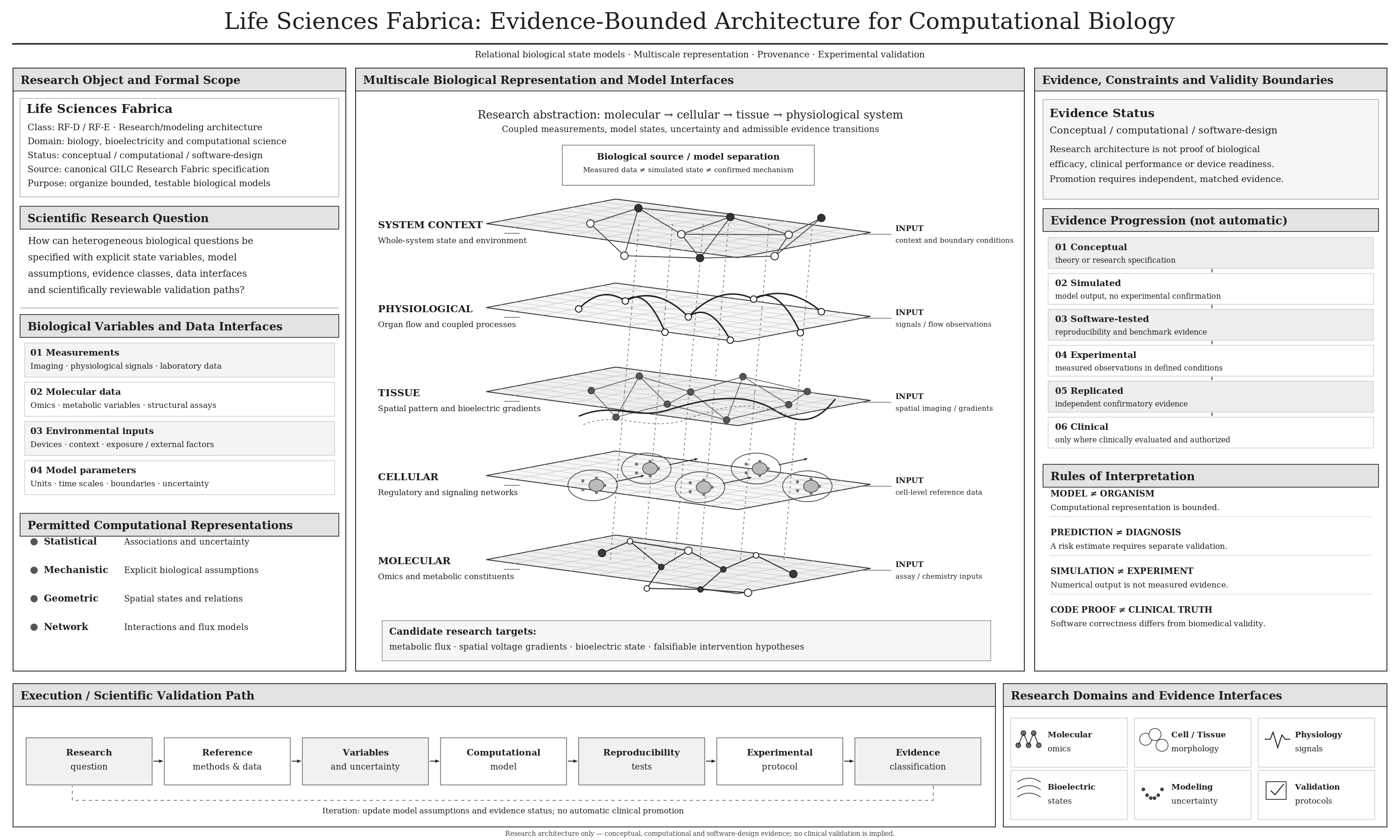
Constitutional Demarcation: A Research Fabric is a bounded epistemological architecture. Structural formulation, digital execution, and proof-assistant replay declare local invariants; they do not constitute unverified physical validation.
Research Question
How can heterogeneous biological questions be represented as bounded computational research systems with explicit state variables, evidence classes, model assumptions, interfaces, and validation paths?
Scientific Basis
Life Sciences Fabrica is an umbrella architecture for structuring research questions in biology and biomedicine. It does not replace established biological, physiological, clinical, or statistical methods. Instead, it provides a project architecture for organizing models, data, constraints, provenance, and future evaluation.
The project media describes intended research directions involving metabolic flux, spatial voltage gradients, bioelectric state, and falsifiable intervention pathways. These are programme concepts and research targets; the media itself is not evidence of biological efficacy.
Architecture
The Fabric can bind:
- biological state variables — measurable or modeled biological quantities;
- data interfaces — imaging, signals, laboratory data, omics, environmental or device data where relevant;
- model layer — statistical, mechanistic, geometric, network, or software representations;
- evidence state — conceptual, simulated, software-tested, experimental, replicated, clinical, etc.;
- validation path — what evidence would be required to move a claim upward;
- provenance layer — source, transformation and version history;
- governance layer — privacy, consent, access, ethics and human review.
Core Invariants
- Model ≠ organism.
- Prediction ≠ diagnosis.
- Software output ≠ clinical evidence.
- Simulation ≠ experimental confirmation.
- Biological source and measurement provenance must remain explicit.
- Model assumptions and validity domain must remain visible.
- Intervention claims require independent experimental and clinical evidence appropriate to the claim.
Evidence & Status
Current evidence class: conceptual, computational and software-design.
No clinical-efficacy or biomedical-validation claim is created by inclusion in Life Sciences Fabrica.
Public Status Boundary
The public site should describe Life Sciences Fabrica as a research architecture, not as a medical device, diagnostic platform, treatment system, validated biological theory, or clinically demonstrated technology.
Research / Implementation Path
- define bounded biological research questions;
- identify established reference models and datasets;
- formalize state variables and uncertainty;
- build computational models;
- test model reproducibility;
- preregister experimental evaluation where appropriate;
- progress to clinical research only under the relevant scientific, ethical and regulatory framework.
Publications & Primary Materials
No directly matched Zenodo publication for Life Sciences Fabrica appears in the current publication registry.
Supporting media
- Decoding the Life Sciences Fabrica: The Canonical Architecture of Living Systems
- Life Sciences Fabrica (LSF) Protocol Deployment
- The Bioelectric Bridge: Operationalizing Life-Scale Pattern Regulation
These are programme media and do not independently validate biological or medical claims.
Related Fabrics
- ZETABODY
- Bioelectric Bridge
- DFT
- Invariant Engineering
- AEGIS
