Skip to content
EPISTEMIC DEMARCATION // Tier 5 (Magnetic Propulsion)
Inspect Results Ledger →

Constitutional Demarcation: A Research Fabric is a bounded epistemological architecture. Structural formulation, digital execution, and proof-assistant replay declare local invariants; they do not constitute unverified physical validation.

Research / Engineering Question ​

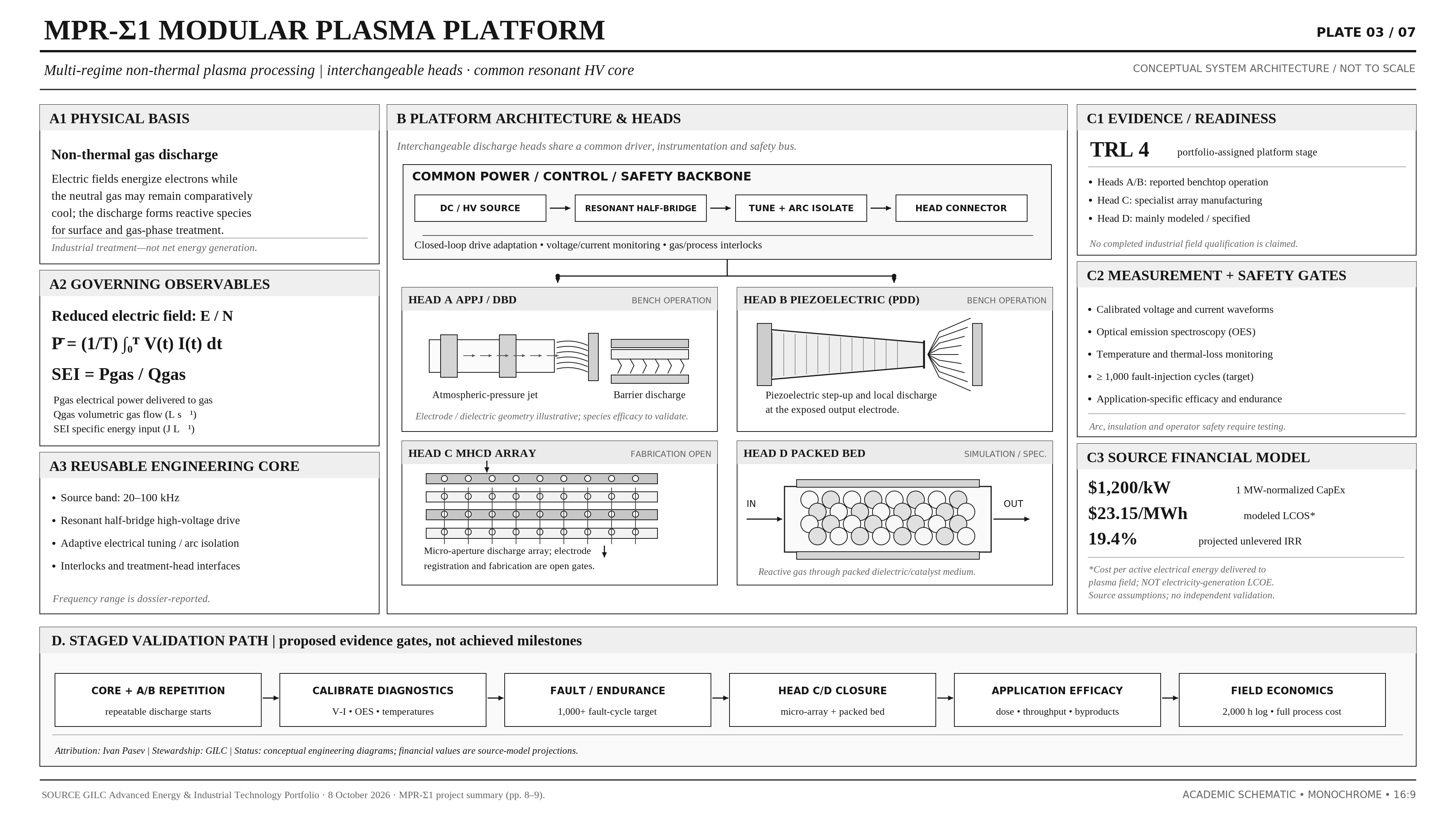
Can multiple plasma-processing regimes be integrated onto a common modular power, control, gas-handling and diagnostics platform while preserving application-specific process envelopes?

Architecture ​

The current reference architecture contains four interchangeable plasma-head families:

  • Head A — APPJ / DBD: atmospheric-pressure plasma jet / dielectric-barrier-discharge functions;
  • Head B — PDD: piezoelectric direct discharge for localized processing;
  • Head C — MHCD: micro-hollow-cathode discharge array for high-density plasma treatment;
  • Head D — packed-bed plasma: plasma-catalytic / gas-treatment configuration.

Shared infrastructure includes:

  • power conversion and high-voltage drive;
  • process-gas / flow and, where required, vacuum handling;
  • real-time control and safety interlocks;
  • optical/electrical/thermal/pressure/flow diagnostics;
  • modular mechanical frame and application fixtures.

Core Invariants ​

  1. each head operates only inside its validated discharge envelope;
  2. applied energy, gas composition and residence time remain measurable;
  3. treatment outcomes are separated from plasma-generation metrics;
  4. cross-head modularity does not imply identical process performance;
  5. safety interlocks dominate process optimization;
  6. emissions/by-products require application-specific measurement.

Evidence & Status ​

The reference dossier/architecture classifies the current platform at TRL 4, with a TRL 5/6 pilot target. These values are programme reference classifications rather than independent certification.

A separate reference illustration includes a 1 MW model and techno-economic parameters; these are model inputs, not measured plant performance.

Application Domains ​

Candidate domains include:

  • surface activation and adhesion preparation;
  • sterilization/decontamination;
  • thin-film or localized materials processing;
  • VOC / gas treatment;
  • plasma-catalytic environmental processing.

Each application requires a separate validation protocol and outcome metric.

Public Status Boundary ​

MPR-Σ1 should not be described as replacing toxic chemical manufacturing in general, or as universally superior to chemical processing. Such claims require application-specific life-cycle, performance, safety and economic comparison.

Research / Implementation Path ​

  • freeze one reference head and use case for first validation;
  • measure discharge stability and energy coupling;
  • characterize treatment efficacy against established baselines;
  • qualify sensors and fault handling;
  • validate repeatability across head swaps;
  • progress to integrated pilot only after process-specific evidence closure.

Publications & Primary Materials ​

No directly matched Zenodo publication for MPR-Σ1 appears in the current publication registry.

Supporting media ​

  • Introduction to MPR-Σ1, a modular handheld continuous-flow plasma — GILC project video; programme description, not independent validation.
  • TOPRI
  • Industry 5.0 Industrial Fabric
  • ETF
  • LPFR
  • Invariant Engineering
Primary Source01_LIBRARY_42/mpr-sigma1.md
Source SHA-256b0d66359f13f51cc58b49484e502b8a7ea9f473007aae640486adb6b7c3f0aa1
TRWM BridgeRF-038__mpr-sigma1__TRWM_BRIDGE_v1.3.md
Corpus StatusSOURCE_GROUNDED_DRAFT_NOT_RELEASED