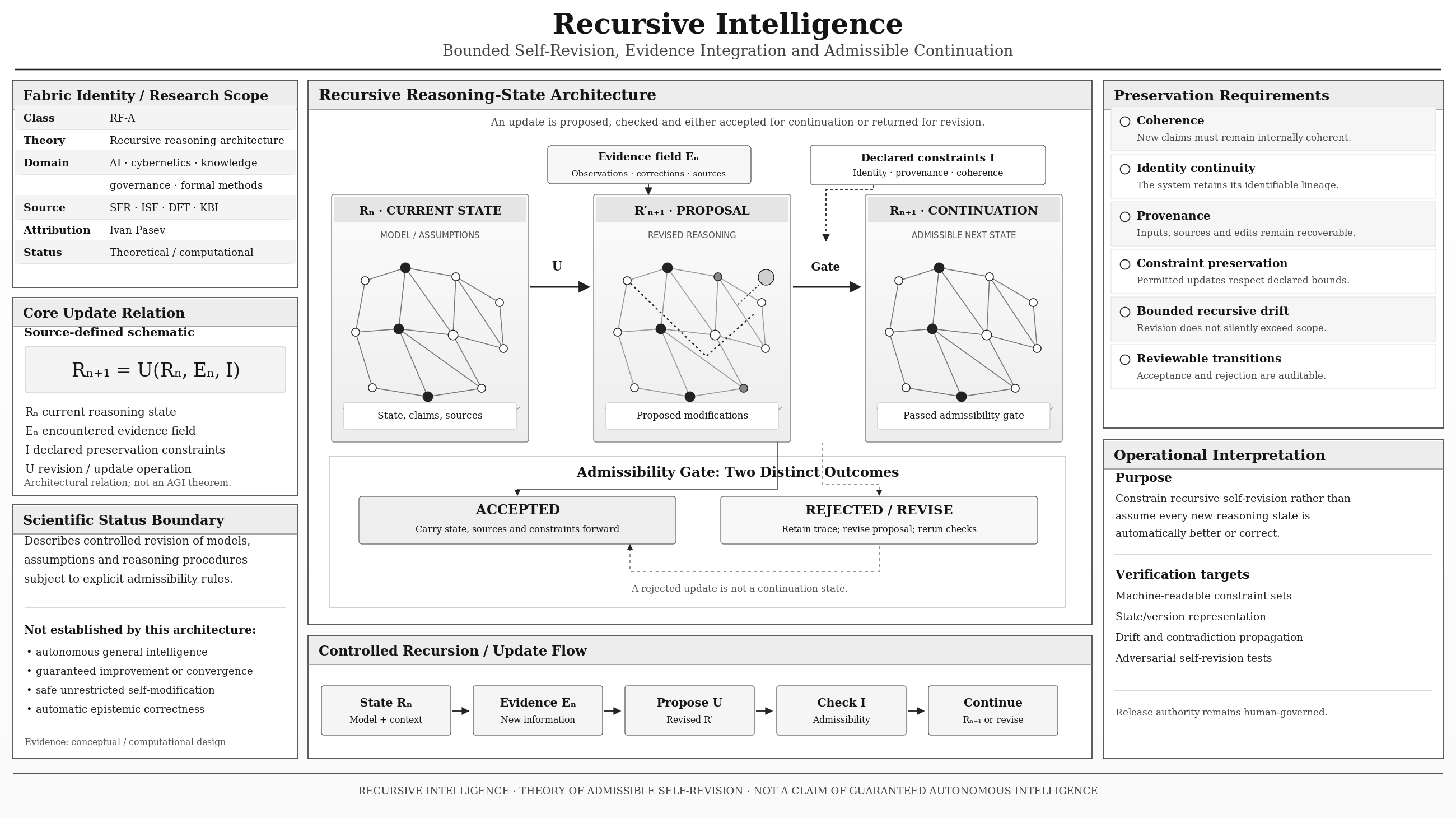
Constitutional Demarcation: A Research Fabric is a bounded epistemological architecture. Structural formulation, digital execution, and proof-assistant replay declare local invariants; they do not constitute unverified physical validation.
Research Question
How can an intelligent system revise its own models, outputs or reasoning procedures without losing coherence, identity, provenance or the constraints that make its continuation admissible?
Scientific Basis
Recursive Intelligence is defined as intelligence capable of operating on its own prior states, models, outputs and procedures while preserving admissibility across recursive transformation.
A schematic update is:
where
The expression is architectural rather than a complete mathematical theory of intelligence.
Architecture
The Fabric contains five principal stages:
- Reasoning state — the current model, assumptions, outputs and operational context.
- Evidence field — new observations, sources, corrections or task information.
- Update operator — the process that proposes a revised reasoning state.
- Invariant gate — checks whether the update preserves required identity, provenance, coherence and admissibility.
- Continuation state — an accepted state becomes the next recursive starting point; rejected states return for revision.
Core Invariants
- coherence preservation
- identity continuity
- evidence/provenance retention
- constraint preservation
- bounded recursive drift
- reviewable state transition
A useful governing principle is:
Improvement without preservation is drift.
This is a methodological principle, not a proved universal theorem.
Validity Domain & Public Status Boundary
Recursive Intelligence does not by itself establish autonomous general intelligence, guaranteed self-improvement, guaranteed monotonic increases in coherence, or safe unrestricted self-modification.
It is a bounded theory of lawful recursive reasoning architecture.
Evidence & Status
Current evidence is conceptual and computational-architectural. Operational realizations include kernelized reasoning and controlled continuation workflows, but these should be evaluated independently from the general theory.
Research / Implementation Path
- define machine-readable invariant sets;
- formalize state and update representations;
- measure recursive drift and contradiction propagation;
- test multi-kernel update sequences;
- develop adversarial self-revision tests;
- preserve human review and release authority.
Publications & Primary Materials
No Zenodo publication in the current publication registry is assigned directly to Recursive Intelligence.
Related Fabrics
- DFT
- Invariant Engineering
- Observer Monad
- KBI / Reasoning Fabric
- CodexStation
- acorpus / UKC
- Quantum Consensus
