Constitutional Demarcation: A Research Fabric is a bounded epistemological architecture. Structural formulation, digital execution, and proof-assistant replay declare local invariants; they do not constitute unverified physical validation.
Research / Engineering Question
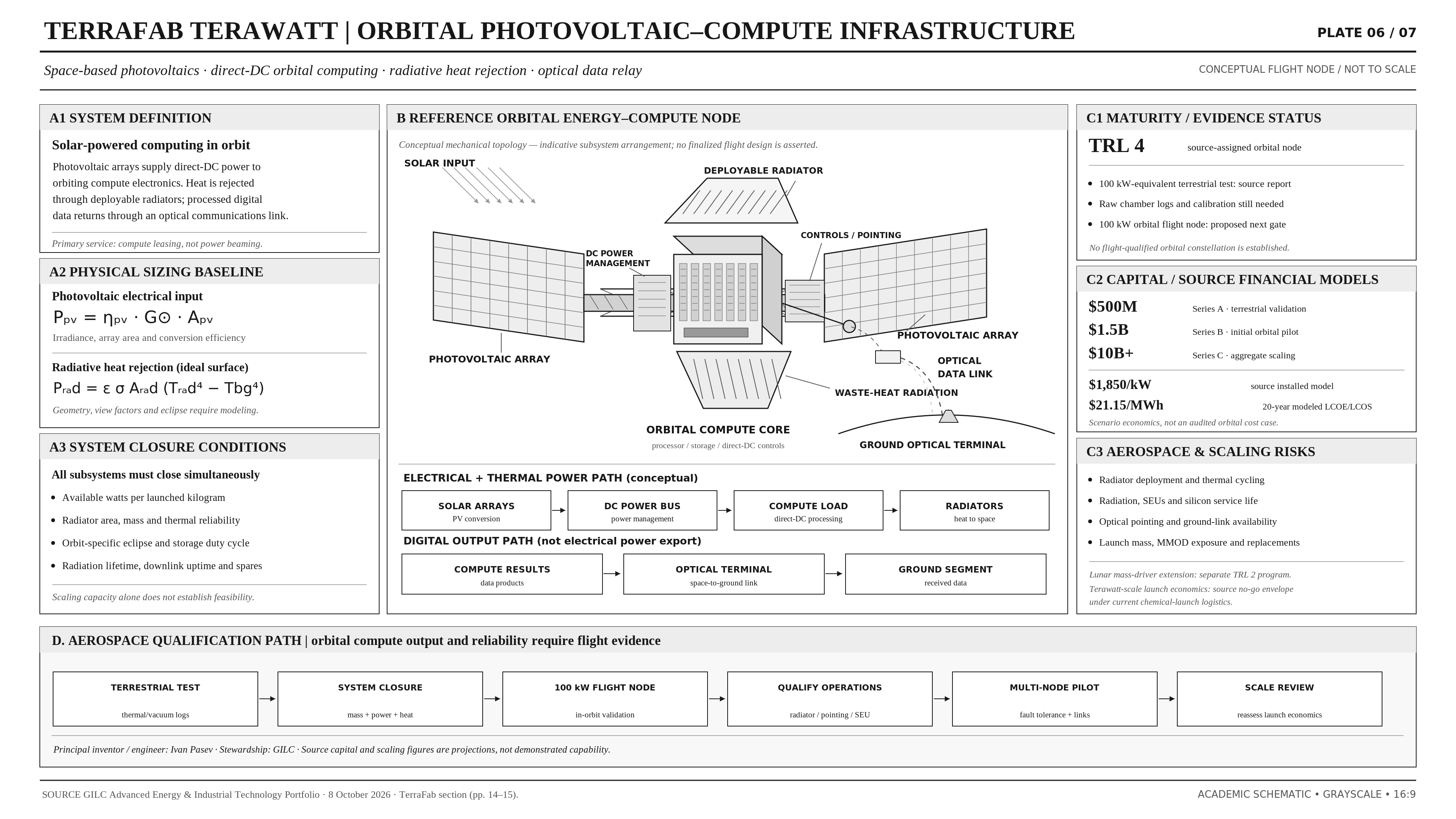
How can solar generation, high-density compute, thermal rejection, communications and orbital operations be designed as one coupled modular infrastructure rather than as loosely integrated spacecraft subsystems?
Architecture
A reference TerraFab node contains:
- deployable high-efficiency solar arrays;
- central compute and power-electronics module;
- power management and distribution;
- deployable radiator manifold;
- attitude-control / orbital-control subsystem;
- high-bandwidth RF or optical downlink;
- scalable truss and modular attachment architecture.
The critical systems constraint is the coupling among power, compute and heat rejection: increased compute is useful only if generation, thermal rejection and communications scale with it.
Core Invariants
- energy generation and compute load must close under a complete power budget;
- heat generation must remain below validated rejection capability;
- attitude/orbital authority must remain sufficient under deployed-array geometry;
- communications throughput must be reported separately from compute throughput;
- launch mass and deployed structure remain explicit constraints;
- orbital node performance and lunar-extension concepts retain separate maturity states.
Reference Model
The current architecture illustration specifies a 100 MW electrical array reference node, radiator temperatures of 400–600 K, a $150/kg launch-cost target, and $1,850/kW node CapEx excluding launch.
These are reference-model assumptions / targets, not demonstrated or independently validated system performance.
The same model labels:
- orbital node: TRL 4
- lunar expansion: TRL 2
These are programme reference classifications.
Public Status Boundary
TerraFab is a systems architecture and feasibility programme. The page must not imply that a 100 MW orbital compute node has been built, launched or economically validated. Launch economics, thermal feasibility, radiation tolerance, assembly, servicing and communications remain major engineering gates.
Research / Implementation Path
- close one reference orbit and mission profile;
- perform end-to-end mass/power/thermal budgets;
- qualify compute hardware under radiation and thermal constraints;
- validate deployable arrays/radiators;
- evaluate optical/RF communications;
- model assembly and launch cadence;
- progress through subsystem demonstrators before integrated orbital validation.
Publications & Primary Materials
No directly matched Zenodo publication for TerraFab appears in the current publication registry.
Related Fabrics
- ScrollCiv Space Fabric
- DFT
- Industry 5.0 Industrial Fabric
- CitizenSolar
- Invariant Engineering
