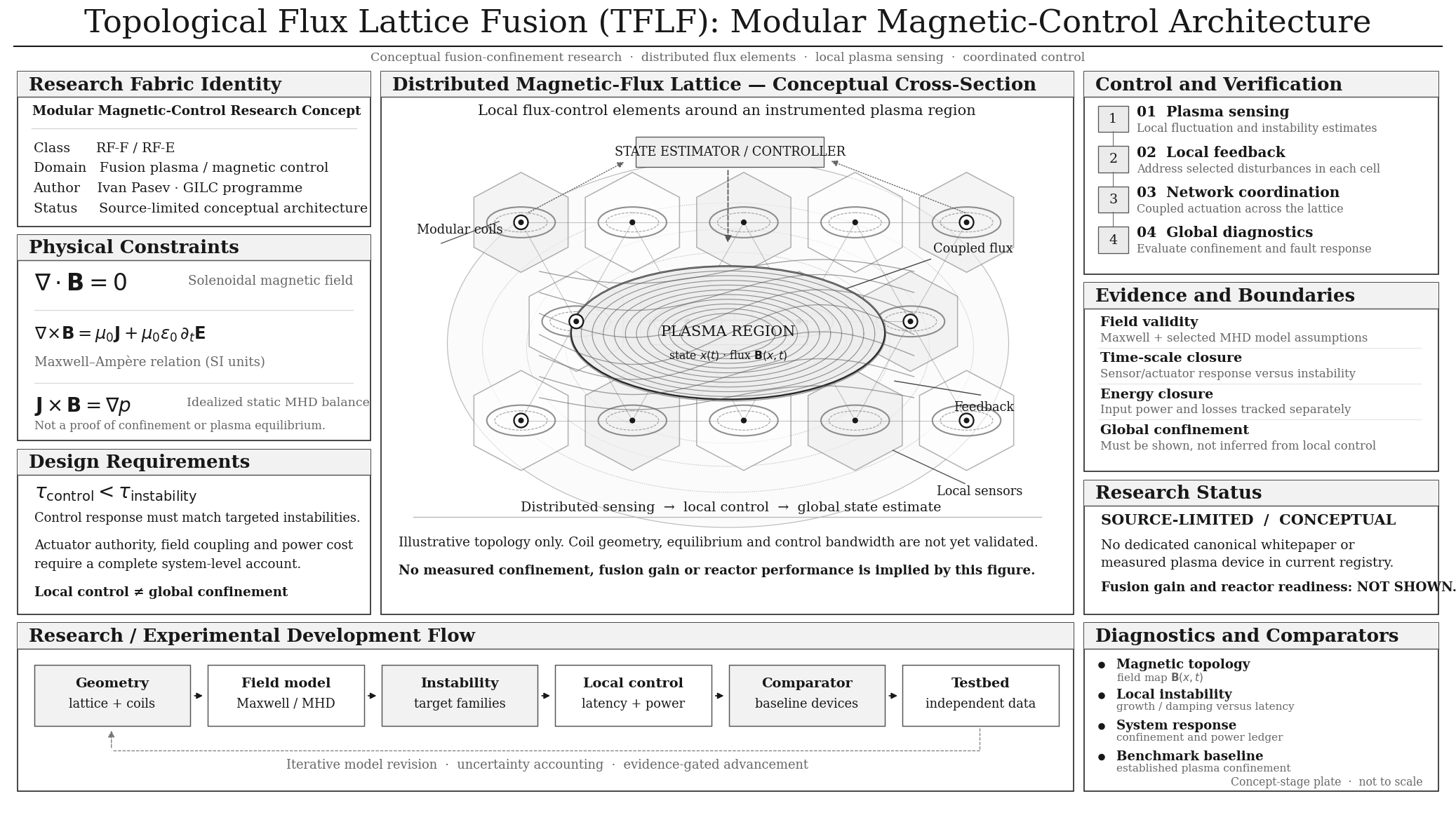
Constitutional Demarcation: A Research Fabric is a bounded epistemological architecture. Structural formulation, digital execution, and proof-assistant replay declare local invariants; they do not constitute unverified physical validation.
Research Question
Can fusion-plasma confinement and instability management be reorganized around a distributed lattice of locally controlled magnetic-flux elements rather than relying exclusively on a single monolithic confinement-field architecture?
Current Source Basis
The current Drive evidence located for TFLF is a registered project-media description:
“DPI: Introduction to Topological Flux Lattice Fusion (TFLF).”
It describes a modular flux-lattice concept with rapid control intended to manage local plasma instabilities.
No dedicated canonical TFLF whitepaper, validated device record, fusion experiment, or measured confinement result was located in the current source pass.
Architecture
At the current evidence level, the concept can be represented through:
- discrete magnetic/flux-control elements;
- local sensing of plasma state;
- fast control kernel;
- distributed coordination among lattice elements;
- global confinement/state estimator;
- safety/fault isolation layer;
- experimental comparator against established confinement approaches.
Core Constraints
- magnetic topology must satisfy Maxwell and plasma-equilibrium constraints;
- local stabilization does not imply global plasma confinement;
- control latency must be matched to the relevant instability timescale;
- actuator authority and energy cost must be included in the full system ledger;
- simulation does not establish fusion performance;
- confinement performance, gain and materials loads require experimental evidence.
Evidence & Status
Current evidence: conceptual/project-media only.
TFLF is not presently represented as a validated fusion-confinement method, net-energy reactor, demonstrated plasma device, or alternative to established tokamak/stellarator/inertial approaches.
Research / Implementation Path
- formalize lattice geometry and actuator model;
- identify target instability families;
- derive control bandwidth and sensing requirements;
- simulate against established plasma models;
- build a non-fusion or low-energy magnetic-control testbed;
- compare local and global stability metrics;
- advance to plasma experiments only after model/control closure.
Publications & Primary Materials
No directly matched TFLF publication appears in the current Zenodo publication registry.
Supporting media
- DPI: Introduction to Topological Flux Lattice Fusion (TFLF) — GILC project video; conceptual project media, not fusion validation.
Related Fabrics
- LPFR
- TOPRI
- FQFT
- Invariant Engineering
- DFT
