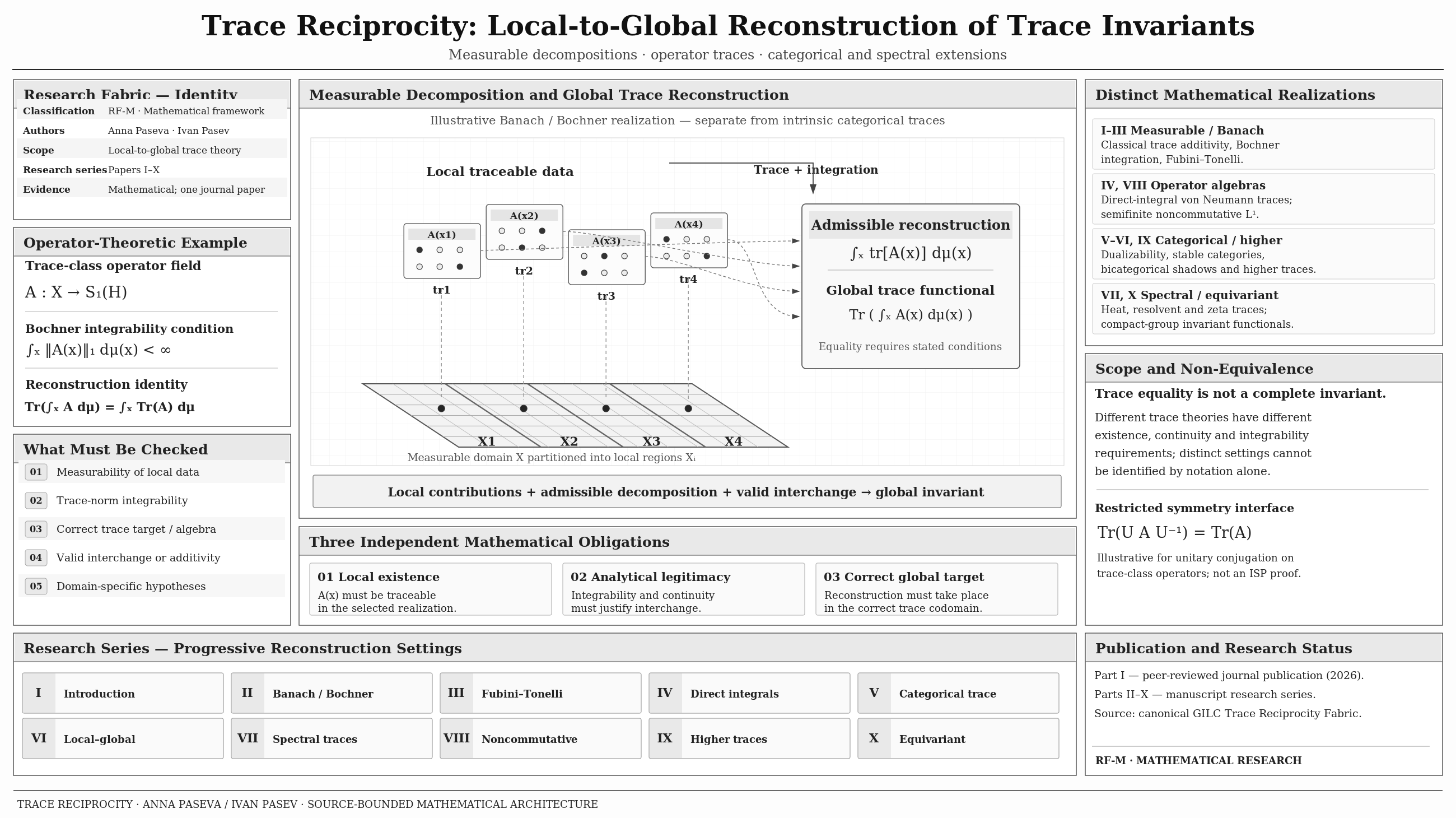
Constitutional Demarcation: A Research Fabric is a bounded epistemological architecture. Structural formulation, digital execution, and proof-assistant replay declare local invariants; they do not constitute unverified physical validation.
Research Question
Under what hypotheses can a global trace invariant be reconstructed rigorously from admissible local, measurable, categorical, operator-algebraic, or symmetry-resolved contributions?
Scientific Basis
The programme begins from finite trace additivity and develops progressively stronger local-to-global reconstruction mechanisms while keeping distinct notions of trace and integration separate. Later papers explicitly distinguish Bochner integration, direct-integral von Neumann traces, intrinsic categorical traces, spectral functional calculus, noncommutative (L^1), higher traces, and symmetry-equivariant reconstruction.
Architecture
The common pattern is:
local traceable data → admissible decomposition / realization → integrability or dualizability conditions → local-to-global reconstruction → global invariant
The exact engine changes by layer:
- bounded linearity in Banach trace-realization spaces;
- Fubini–Tonelli and dominated convergence;
- decomposable traces in von Neumann algebras;
- dualizability and additivity in stable monoidal categories;
- functional calculus for spectral invariants;
- noncommutative (L^1);
- bicategorical shadows and higher trace targets;
- compact-group equivariance and invariant functionals.
Core Invariants / Mathematical Conditions
There is no single universal condition across every paper. The programme repeatedly requires the relevant subset of:
- measurability;
- absolute / trace-norm integrability;
- bounded linearity or normality of the trace;
- dualizability for intrinsic categorical traces;
- Fubini-compatible reconstruction for iteration;
- correct trace target and ambient algebra;
- explicit continuity / summability hypotheses;
- symmetry invariance for equivariant forms.
Research Series I–X
- I — Introduction: measurable local-to-global trace principle.
- II — Foundations: graded trace-class Banach realization and Bochner interchange.
- III — Fubini–Tonelli: product measures, iterated integration, dominated convergence.
- IV — Direct Integrals: tracial von Neumann algebras and noncommutative (L^1) disintegration.
- V — Categorical Trace: dualizability and finite trace additivity in stable symmetric monoidal (\infty)-categories.
- VI — Local-to-Global: hierarchical, iterated, refinement-invariant reconstruction.
- VII — Spectral: heat traces, resolvents, spectral zeta functions, and determinant-type invariants.
- VIII — Noncommutative: semifinite measurable operators and noncommutative (L^1).
- IX — Higher Traces: Hochschild, Lefschetz, Hattori–Stallings, bicategorical shadows, and higher traces.
- X — Symmetry-Equivariant: compact-group actions, orbit reduction, invariant trace functionals, and restricted ISP interface.
Validity Domain & Public Status Boundary
The programme should not flatten distinct trace theories into one universal identity. Each layer has its own existence, integrability, dualizability, continuity, or decomposition hypotheses. In particular, scalar trace equality is not a complete invariant of structural equivalence.
Publications & Primary Materials
- Trace Reciprocity under Measurable Decomposition for Trace-Class Endofunctors: Introduction to Trace Reciprocity Framework — International Scientific Journal Industry 4.0, 2026
- Papers II–X — current manuscript series supplied in the canonical research corpus.
Related Fabrics
Infinite Symmetry Principle · Extended TQFT · Invariant Engineering · DFT · Observer Monad
