Skip to content
EPISTEMIC DEMARCATION // Tier 5 (Biomorphic Robotics)
Inspect Results Ledger →

Constitutional Demarcation: A Research Fabric is a bounded epistemological architecture. Structural formulation, digital execution, and proof-assistant replay declare local invariants; they do not constitute unverified physical validation.

Research Question ​

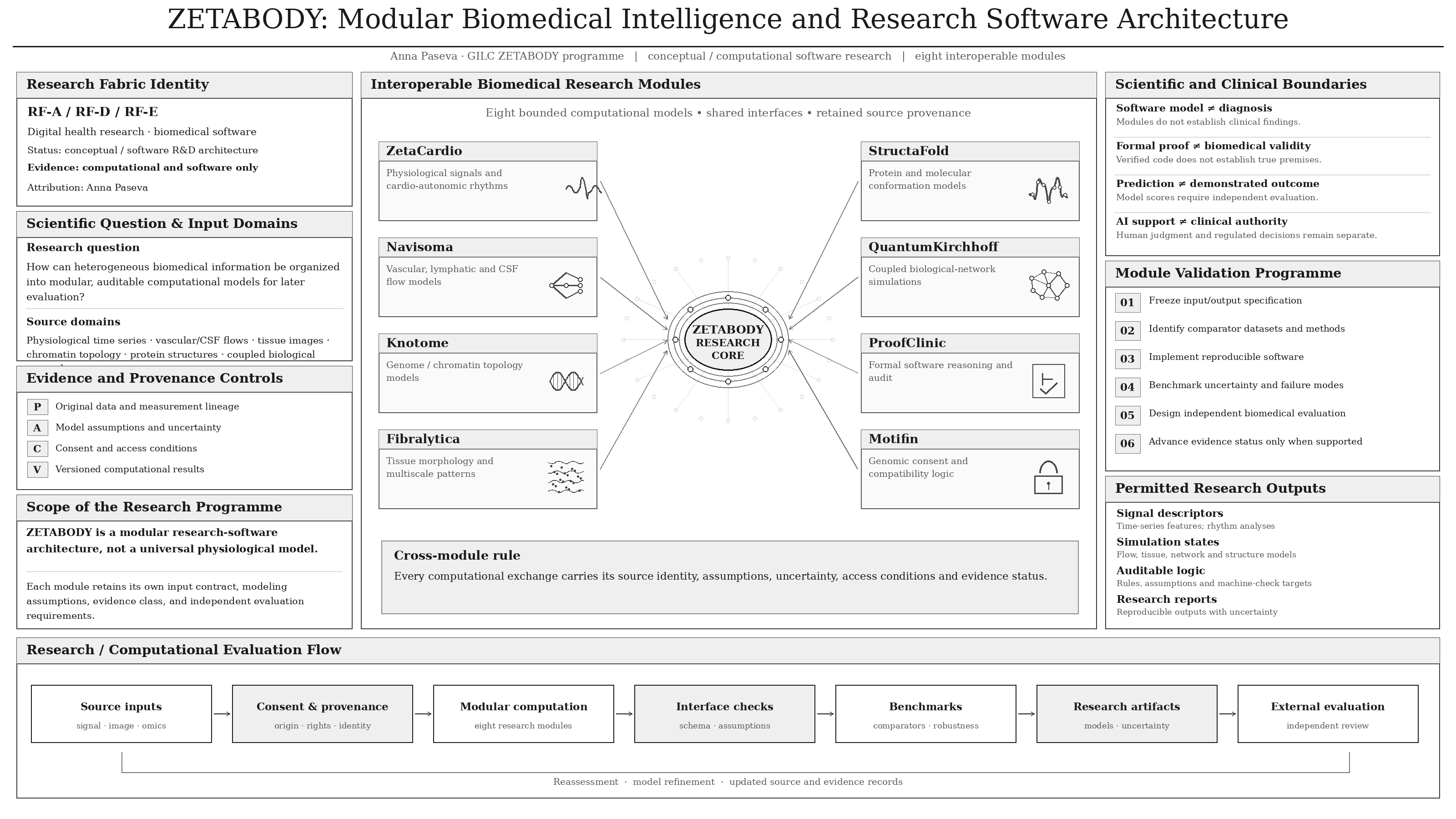
How can heterogeneous biomedical information be organized into modular computational models that remain interpretable, auditable, provenance-aware, and suitable for later scientific evaluation?

Evidence Boundary ​

ZETABODY and all current modules have conceptual/software evidence only.

This means:

  • no module is presented as clinically validated;
  • no module is presented as a medical device;
  • no module is presented as demonstrating diagnosis, prognosis, treatment efficacy, or prevention;
  • proposed biomarkers, scores, alerts, classifications, or intervention pathways are software/research constructs until independently evaluated;
  • formal verification can verify software/logical properties of a specification, but does not establish biomedical truth.

Architecture ​

ZETABODY is organized as a modular system rather than a single universal health model.

Signal and physiological-state modules ​

  • ZetaCardio — cardio-autonomic and related physiological signal/rhythm modeling.
  • Navisoma — vascular, lymphatic, cerebrospinal-fluid and related flow-oriented modeling.

Structural and biological-pattern modules ​

  • Knotome — genomic/chromatin topology and structural-state modeling.
  • Fibralytica — tissue morphology, deformation and multiscale image/pattern analysis.
  • StructaFold — protein conformation and molecular/microenvironment structural modeling.
  • QuantumKirchhoff — network/field-style computational modeling of coupled biological or microenvironment states.

Verification and governance modules ​

  • ProofClinic — formally auditable clinical-reasoning software logic and verification layer.
  • Motifin — genomic identity, compatibility, consent and rule-based targeting/governance layer.

The modules may exchange computational representations, but outputs retain the evidence status of the underlying source data and model.

Core Invariants ​

  1. Software model ≠ clinical diagnosis.
  2. Formal proof of code/specification ≠ proof of biomedical validity.
  3. Each module must expose source data, assumptions and uncertainty.
  4. Cross-module inference must preserve provenance.
  5. No module may silently promote conceptual or simulated outputs into clinical evidence.
  6. Consent and access constraints must remain attached to relevant data and outputs.
  7. Human clinical judgment and regulated workflows remain outside the authority of the software unless separately validated and authorized.

Current Module Registry ​

ModulePrimary software/research roleEvidence
ZetaCardioPhysiological signal/rhythm modelingConceptual/software
NavisomaVascular/lymph/CSF flow modelingConceptual/software
KnotomeGenome/chromatin topology modelingConceptual/software
FibralyticaTissue morphology/fractal-wavelet/topological analysisConceptual/software
StructaFoldProtein/conformation and molecular-structure modelingConceptual/software
QuantumKirchhoffCoupled biological-network / microenvironment modelingConceptual/software
ProofClinicFormal reasoning, verification and audit logicConceptual/software
MotifinGenomic integrity/compatibility/consent logicConceptual/software

Evidence & Status ​

Current evidence is limited to:

  • architecture and module definitions;
  • computational concepts;
  • software/formal-verification design;
  • prototype-oriented research specifications where available.

There is no established clinical evidence layer in the current ZETABODY registry.

Research / Implementation Path ​

  • specify module input/output contracts;
  • define reference datasets and baseline methods;
  • implement reproducible software pipelines;
  • benchmark against established computational methods;
  • perform retrospective research evaluation where lawful and appropriate;
  • define prospective validation protocols only after software performance is characterized;
  • keep clinical and regulatory claims gated until independently supported.

Publications & Primary Materials ​

No directly matched Zenodo publication for ZETABODY appears in the current publication registry.

Supporting media ​

  • ZETABODY: Real-Time Intelligence for Human Health — project media; its predictive-health language is a programme objective, not validated clinical evidence.

Modules ​

Nested module records are maintained in the ZETABODY modules directory:

  • ZetaCardio
  • Navisoma
  • Knotome
  • Fibralytica
  • StructaFold
  • QuantumKirchhoff
  • ProofClinic
  • Motifin
  • Life Sciences Fabrica
  • AEGIS
  • DFT
  • Invariant Engineering
Primary Source01_LIBRARY_42/zetabody.md
Source SHA-256f8f628ecd295a524cd24903ed011370bb90144a5e2f47e2a2a0410f79ea2f878
TRWM BridgeRF-034__zetabody__TRWM_BRIDGE_v1.3.md
Corpus StatusSOURCE_GROUNDED_DRAFT_NOT_RELEASED