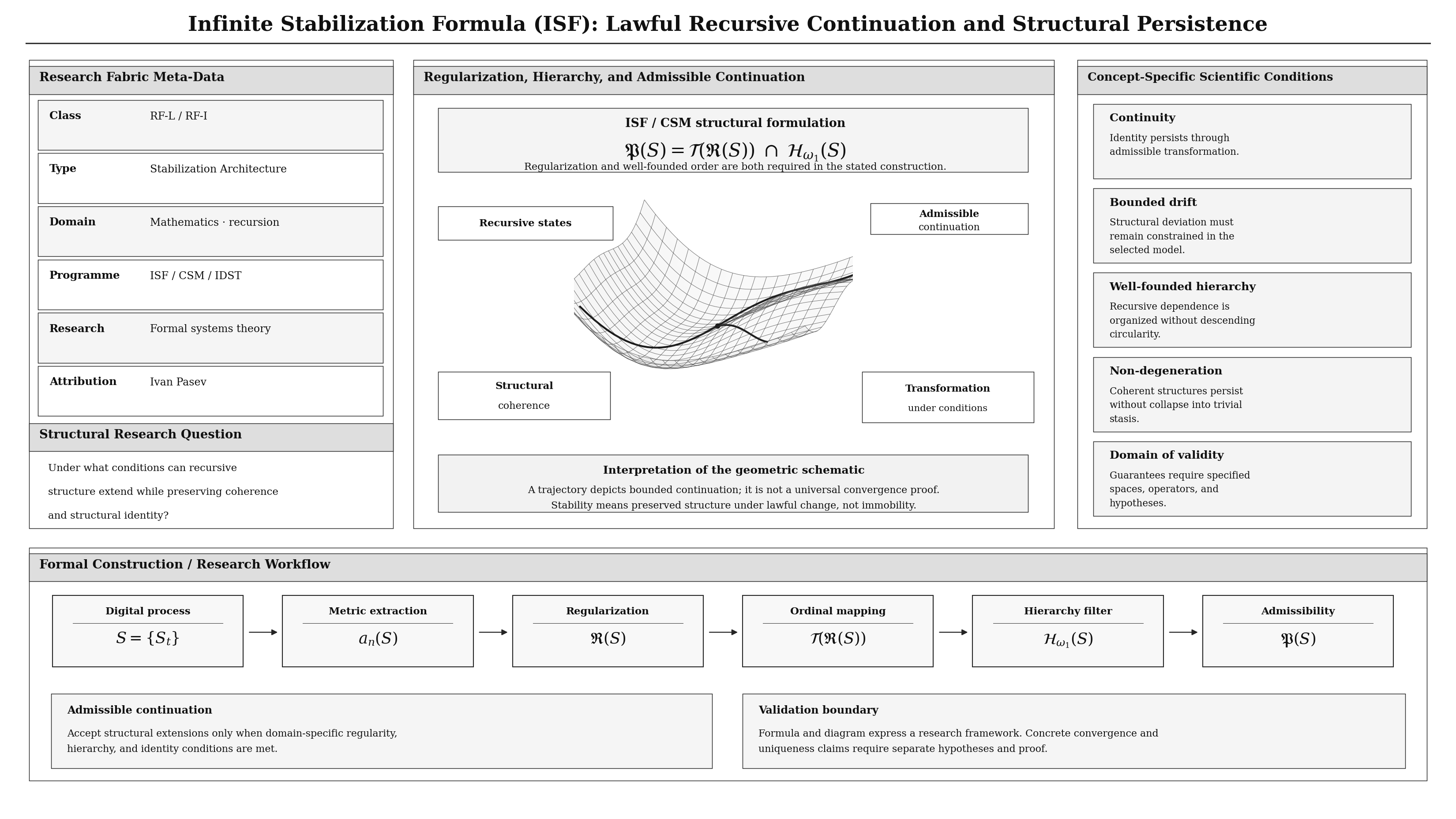
Constitutional Demarcation: A Research Fabric is a bounded epistemological architecture. Structural formulation, digital execution, and proof-assistant replay declare local invariants; they do not constitute unverified physical validation.
Research Question
What must remain invariant for a system to preserve lawful identity across transformation, recursion, scaling, encoding, and change of viewpoint?
Scientific Basis
SFR defines ISP as a high-level structural law rather than a narrow geometric symmetry principle. Its schematic architecture combines a bounded/regularized representation, an admissible transformation layer, and well-founded coherence conditions.
Architecture
- bounded or regularized representation of a system;
- admissible transformation or translation;
- invariant-preservation test;
- well-founded coherence condition;
- classification into preserved versus non-preserved structure.
Core Invariants / Conditions
- preservation of an invariant core;
- admissibility of the transformation;
- regularization / bounded representation where required;
- well-founded coherence;
- explicit distinction between trace equivalence and full structural equivalence.
Validity Domain & Public Status Boundary
The broad ISP formulation is a meta-structural proposal. The SFR itself presents its compact formula schematically. The Trace Reciprocity symmetry paper supplies a restricted rigorous interface under explicit compact-group and invariant-functional hypotheses; that restricted result should not be presented as proof of the entire ISP.
Publications & Primary Materials
- Pasev's Infinite Symmetry Principle: A Unified Framework for Infinite-Scale Logical Systems
- Trace Reciprocity Framework X — Symmetry-Equivariant Trace Reciprocity
Related Fabrics
Trace Reciprocity · Invariant Engineering · IDST · FQFT · DFT · Observer Monad
