Skip to content
EPISTEMIC DEMARCATION // Tier 5 (Lattice Plasma Reactor)
Inspect Results Ledger →

Constitutional Demarcation: A Research Fabric is a bounded epistemological architecture. Structural formulation, digital execution, and proof-assistant replay declare local invariants; they do not constitute unverified physical validation.

Programme Definition ​

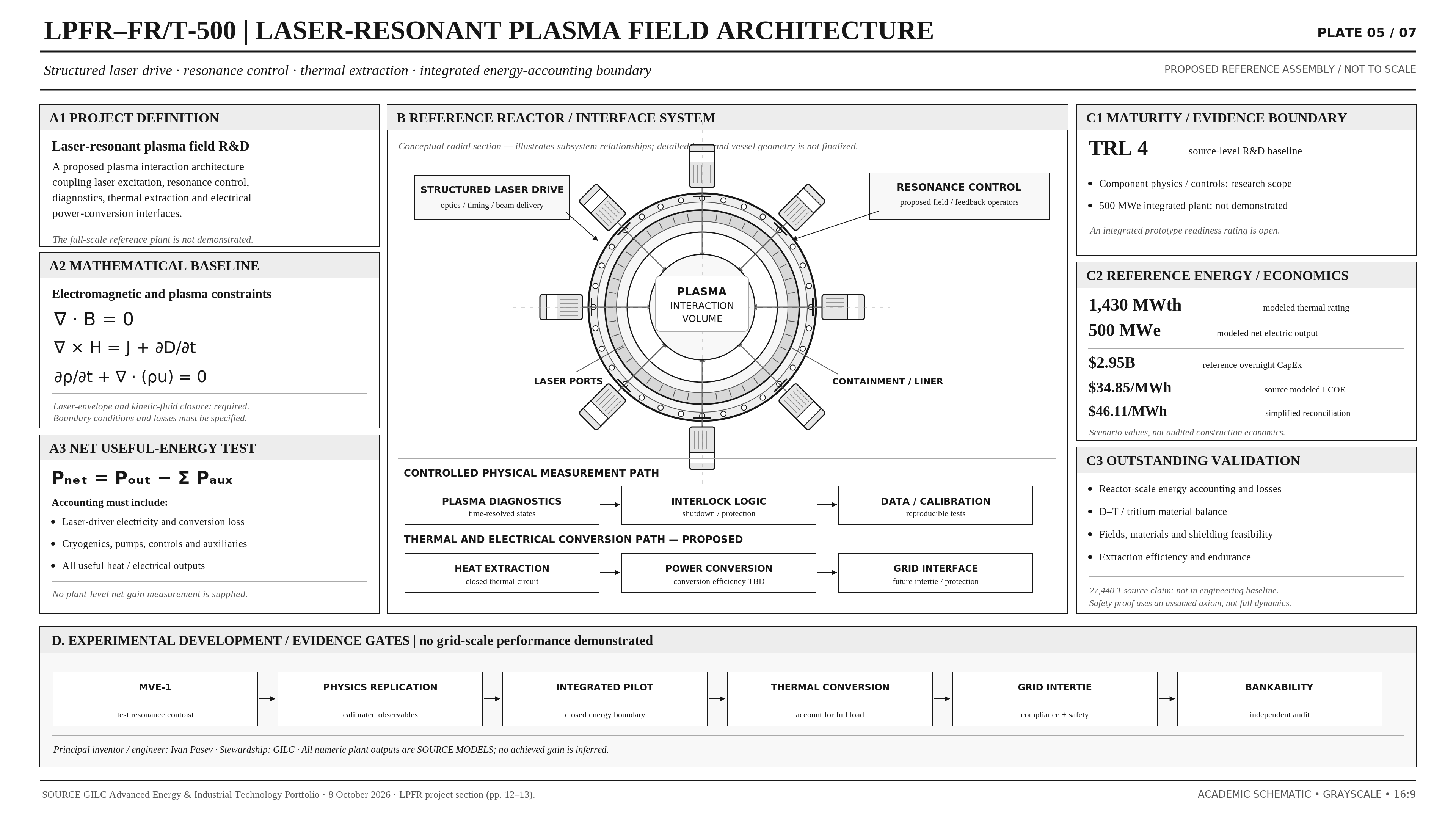
LPFR = Laser–Plasma Field Resonance.

The current canonical constitution defines LPFR as an umbrella science, engineering and reactor-systems programme, broader than any single hypothesis, benchmark, reactor architecture or application.

Its causal domain spans the physical sequence:

field⟶medium/plasma⟶particle state⟶transport⟶target interaction⟶nuclear / non-nuclear process⟶engineered reactor

LPFR addresses the non-linear coupling between ultra-intense coherent electromagnetic fields and dense plasma manifolds. Rather than treating plasma turbulence and instabilities as stochastic loss mechanisms alone, the programme models resonance manifolds that organize energy deposition, particle acceleration, and downstream processes under strict invariant conservation laws.

The Six Canonical Sub-Disciplines ​

The LPFR architecture is organized into six formal, decoupled sub-disciplines:

1. LPFR-SCI — Scientific Foundations & Experimental Physics ​

Focuses on relativistic laser-plasma interaction physics, field-theoretic resonance conditions, non-perturbative QED field limits, and high-energy-density plasma regimes. It governs all laboratory experimental designs and parameter space explorations.

2. LPFR-TECH — Devices & Enabling Technologies ​

Encompasses ultra-fast pulse shaping, petawatt-class optical chain synthesis, relativistic electron/ion injector design, high-gradient accelerating structures, and precision cryogenic target delivery mechanisms.

3. LPFR-SYS — Systems, Installations & Facilities ​

Governs high-vacuum chamber geometries, high-repetition-rate pulse containment systems, magnetic divertor topologies, radiation and neutron shielding envelopes, and balance-of-plant integration.

4. LPFR-DIGITAL — Digital Twin, Evidence & Control ​

Develops GPU-accelerated Particle-in-Cell (PIC) simulation suites, real-time machine-learning plasma state estimators, closed-loop multi-kHz pulse feedback systems, and cryptographic provenance ledgers for laboratory telemetry.

5. LPFR-R — Reactor Science & Energy Systems ​

Coordinates advanced confinement concepts and energy balance architectures. It oversees four dedicated process families:

  • FUS — Fusion-dominant confinement and ignition topologies;
  • CAS — Cascade/network-dominant non-equilibrium nuclear channels;
  • HYB — Hybrid drive and sub-critical energy amplification manifolds;
  • SRC — Neutron/gamma source and irradiation test facilities. The RPA-500 candidate architecture is formally classified under LPFR-R/FUS/RPA-500.

6. LPFR-X — Applications & Industrial Translation ​

Bridges basic scientific results to industrial and civilizational deployment: medical radioisotope synthesis, compact proton beam cancer therapy, advanced non-destructive materials testing, and long-horizon grid-scale energy systems.

The FPNC Relationship ​

The Field-to-Particle Nuclear Cascade Framework (FPNC) is maintained as an underlying theoretical module under:

LPFR-SCI/FPNC

Epistemic Boundary Notice

FPNC is a theoretical model of field-induced nuclear transitions within LPFR-SCI. FPNC is not LPFR as a whole, and FPNC simulation passes do not constitute physical reactor qualification or empirical validation.

Constitutional Epistemic Firewalls ​

The LPFR constitution enforces eight immutable evidence firewalls that govern every public claim, specification, and engineering assessment:

Firewall AxiomConstitutional Operational Boundary
EXECUTABLE ≠ VALIDATED ≠ DESIGN-CREDITCode execution in a simulation sandbox confirms numerical stability, not physical fact or engineering readiness.
MEASURED ≠ DERIVED ≠ MODELLED ≠ INFERRED ≠ CLAIMEDDirect laboratory sensor telemetry must never be conflated with derived metrics, fitted models, or theoretical claims.
ENERGY CONTROL ≠ ENERGY SOURCEThe capability to steer, shape, or compress electromagnetic energy does not demonstrate net energy generation.
TARGET GAIN ≠ NET PLANT GAINLocal energy multiplication at the laser-plasma interaction point (Qtarget>1) does not imply net facility electrical output (Qplant>1).
SUBSYSTEM PASS + SUBSYSTEM PASS ≠ INTERFACE PASSIsolated performance of optical and vacuum subsystems does not guarantee coupled system-level stability under load.
MODEL REPARAMETERIZATION ≠ NEW PHYSICSAdjusting empirical constants or coordinate representations to fit anomalies does not prove novel physical laws.
MACHINE-CHECKED MODEL ≠ PHYSICAL CERTIFICATIONA formal proof assistant (Lean 4) certification verifies logical consistency; it does not substitute for empirical measurement.
ANOMALY ≠ NEW PHYSICSUnexplained experimental residuals require rigorous noise, calibration, and artifact elimination before asserting new phenomena.

Evidence State & Results Ledger Integration ​

The LPFR programme maintains strict demarcation between theoretical architecture and physical demonstration:

  • Programme Level: Umbrella research and engineering framework; not a certified commercial reactor technology.
  • Formal Status: Grounded in admitted v1.4.1 canonical profile RF-040, TRWM model bridge TRWM_MODEL_LPFR.md, and primary research source 01_LIBRARY_42/RF-040_LPFR.md.
  • Results Ledger Certification: Active empirical constraints and engineering bounds are certified in the host Results Ledger:
    • RES-LPFR-ENG-01 — LPFR Core Laser-Plasma Confinement Boundary (Tier 5 Engineering Framework).
    • RES-TRWM-LPFR-01 — TRWM Model Profile Qualification (Tier 3 Digital Twin & Simulation Replay).

Research & Engineering Progression ​

All LPFR development follows a unidirectional value cascade:

Discovery⟶Validation⟶Formalization⟶Digitalization⟶Device⟶System⟶Installation⟶Demonstrator⟶Reactor / Product⟶Licensing

No downstream milestone is guaranteed by an upstream laboratory observation. Each step requires independent experimental gating.

Canonical Publications & Sources ​

Primary Research Sources ​

  • 01_LIBRARY_42/RF-040_LPFR.md — Admitted v1.4.1 research profile (SHA-256: 63D4CFD1E5EE2BFD47AE31DFEBBCF7FEBE829A02A0E476717540D36CEE091176).
  • TRWM_MODEL_LPFR.md — Model specification and digital twin boundary definition.
  • GILC LPFR Programme Constitution — RC1 (Institutional governance specification).
  • START_HERE — GILC LPFR Programme — RC1 (Programme onboarding and laboratory safety protocols).

Explanatory Media ​

  • The Architecture of Laser-Resonant Plasma Fields — GILC programme video. Explicitly classified as educational explanatory media; carries no empirical validation authority.
Primary Source01_LIBRARY_42/lpfr.md
Source SHA-2562f3b28380ae4f9b695c7cea82f2b5511e2df9de1160ebc0920110e368486aae5
TRWM BridgeRF-040__lpfr__TRWM_BRIDGE_v1.3.md
Corpus StatusSOURCE_GROUNDED_DRAFT_NOT_RELEASED

Reader Navigation ​